State public health data shows that measles vaccination rates among Illinois schoolchildren are above the threshold recommended to prevent outbreaks of the highly contagious viral infection.
On Feb. 16, the Illinois Department of Public Health reported the state’s first measles case of 2026, linked to a church in Collinsville where possible exposure may have happened on Feb. 8. On March 12, the first 2026 case of confirmed measles was announced by health officials in DeKalb County, tracked possibly to exposure at a local Walmart and post office.
On March 31, the Cook County Health Department warned of possible measles exposure at O’Hare International Airport in Chicago and two locations in Niles, including a Fresh Farms grocer and a Marshalls.
Cook County health officials said they’d tracked the possible exposures to a person who’d been contagious with measles at the time. That person also visited the Endeavour Health Immediate Care Center in Mt. Prospect days earlier.
Contact tracing isn’t new. It was prominently used during the coronavirus pandemic, especially in the early days, as little was yet known about how the virus spread.
“We’ve been actively doing contact tracing, and at this time, there are no specific issues to report,” DeKalb County Health Department administrator Lisa Gonzalez said.
The last time DeKalb County reported a measles case was 2019, according to the county’s health department. Countrywide in 2025, the U.S. marked its worst year for measles in more than three decades, The Associated Press reported. The IDPH reported 14 cases in Illinois in 2025.
Although falling vaccination rates nationwide have concerned health officials, in Illinois, vaccination rates for measles are at the threshold recommended for preventing outbreaks.
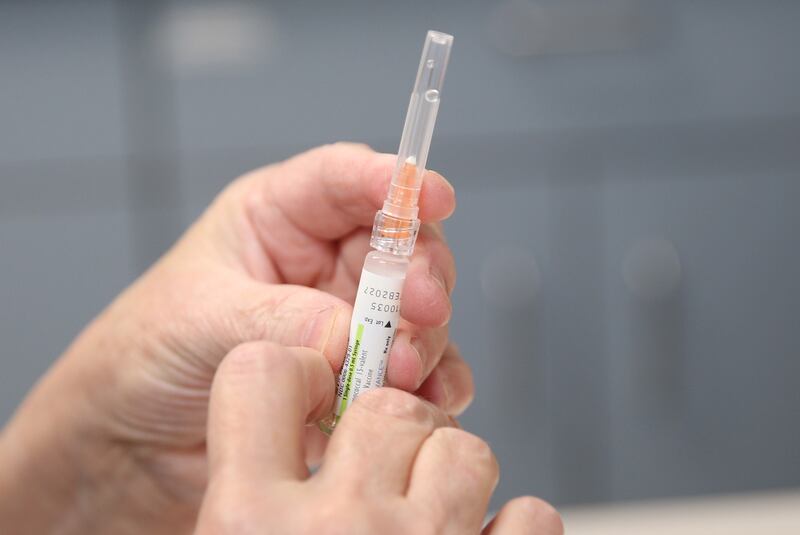
The best way to prevent measles infection is to get vaccinated, health experts said. The MMR vaccine – for measles, mumps, and rubella – is commonly given to children over the age of 1.
“Because once you are exposed and unvaccinated, obviously, it’s too late for the vaccine,” Gonzalez said. “So, know your vaccine status, make sure that you are aware of if you’re up-to-date on your vaccine, and then if you’re not and you are potentially exposed, then you would monitor for those symptoms.”
The IDPH tracks vaccination rates based on school data. That data shows that more than 95% of Illinois students have been vaccinated for measles. According to the U.S. Centers for Disease Control and Prevention, at least 95% of the population with both doses of the measles vaccine is effective in preventing outbreaks.
How is measles spread?
“Measles is a highly contagious viral disease that spreads easily from person to person through the air,” Gonzalez said.
As with many viruses, getting measles can cause complications that can lead to more serious health risks.
According to the CDC, 1 in 5 unvaccinated people in the U.S. will be hospitalized when they get measles. 1 child in every 20 with measles will also get pneumonia, which can lead to death. About 1 child in every 1,000 with measles will also develop encephelitis (swelling of the brain). This can lead to convulsions and leave the child deaf or with an intellectual disability. Nearly 1 to 3 of every 1,000 children who become infected with measles will die from respiratory and neurological complications.
If you’re pregnant and have not had the MMR vaccine, measles may cause premature birth or the baby to be of low birth weight.
Where do outbreaks tend to happen?
Measles outbreaks tend to occur in areas with low vaccination coverage. Common settings included crowded, enclosed spaces, such as schools, daycare centers, public transport, and healthcare facilities, according to the La Salle County Health Department.
How contagious is measles compared to other diseases?
According to the American Medical Association, “measles is one of the most contagious diseases and is transmitted by direct contact with infectious droplets and also via airborne spread when an infected person breathes, coughs or sneezes.”
What symptoms to look out for?
“They’re looking for some specific symptoms,” Gonzalez said. “Usually, the symptoms begin with fever, cough, runny nose, and red or watery eyes, but then it’s typically followed by a distinct rash that usually starts on the face and spreads downward.”
Other symptoms to watch for: Fever of 101F or higher, cough, runny nose, rash that can be red and blotchy that starts at the hairline and moves toward the face, spreading downward. Measles starts with cold-like symptoms but includes a rash usually. While flu symptoms can be similar, people with the flu usually don’t develop a rash, and flu symptoms tend to be sudden and of abrupt onset, according to the La Salle County Health Department.
Can someone spread measles before they know they’re sick?
Someone with measles is contagious from four days before the onset date of the rash through the end of the fourth day after the onset of the rash (the onset date of the rash is called “day zero”), La Salle County public health officials said.
During this time, those infected should stay home and not attend work, school, or social activities unless they are seeking medical care. If seeking medical care, patients should call ahead to the medical facility and local health department to make arrangements to minimize exposures.
Who is at the most risk?
Babies, older people, and those with compromised immune systems.
“We are concerned most about those who are unvaccinated,” Gonzalez said. “Measles can lead to serious complications, especially in young children, pregnant women, and people who already have a weakened immune system.” Children younger than 5, adults older than 20. Infants under 12 months are particularly vulnerable as they are too young for the first MMR vaccine dose.
What is the MMR vaccine?
The best way to prevent measles is through the MMR vaccine, which protects against measles, mumps, and rubella, La Salle County public health experts said. Almost everyone who has not had the MMR vaccine will get sick if they are exposed to those viruses. The vaccine keeps children from missing school or childcare, and adults from missing work to care for a sick child. Vaccination also limits the size, duration, and spread of outbreaks.
The measles vaccine is routinely recommended for children at 12-15 months of age, with a second dose recommended at 4-6 years of age. One dose of the MMR vaccine is required for those 12 months and older to attend child care facilities, and two doses of MMR are required in Illinois for kindergarten through 12th-grade children.
What if I think I’ve been exposed?
The best course of action, Gonzalez said, is to alert health officials should anyone suspect that they have measles.
“They would definitely want to call their healthcare providers,” Gonzalez said. “We are asking people if they are symptomatic with symptoms like measles, they should call ahead before presenting to any local medical facility.”
County data
According to the IDPH, the following are the percentages of school-aged children are immunized against measles:
- DeKalb County: 96.8%
- McHenry County: 95.7%
- Kane County: 95.6%
- Kendall County: 96.3%
- Kankakee County: 94.7%
- DuPage County: 95.9%
- Will County: 96.3%
- La Salle County: 97%
- Ogle County: 95.2%
- Lee County: 96.7%
- Bureau County: 95.5%
- Putnam County: 97.3%
- Whiteside County: 96.6%
- Grundy County: 92.4%
- Lake County: 95.5%
:quality(70)/author-service-images-prod-us-east-1.publishing.aws.arc.pub/shawmedia/afeba7c5-6912-4fdf-967f-edcf9aadb18e.jpg)
:quality(70)/author-service-images-prod-us-east-1.publishing.aws.arc.pub/shawmedia/670e1b81-921a-4140-9c50-69b66cad217c.jpg)