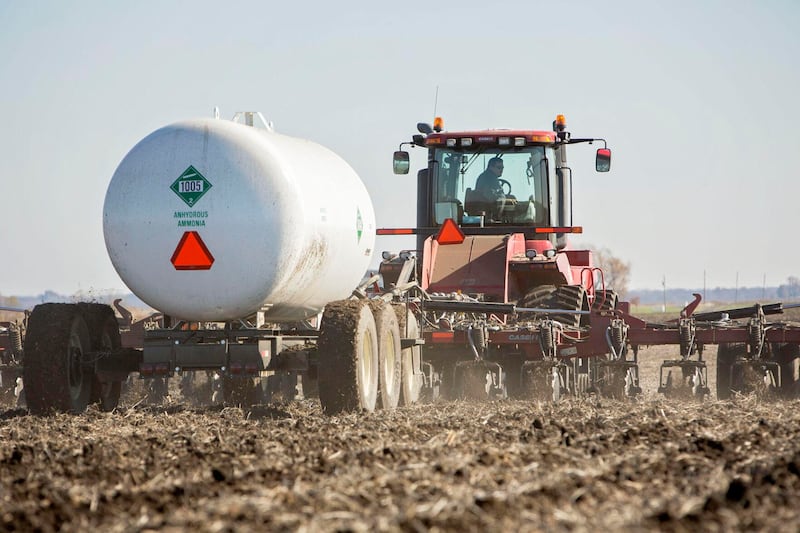
The war in Iran is raising the price of fertilizer for farmers for the same reason it’s increasing gas prices for everyone.
The Strait of Hormuz, a key shipping route threatened by the conflict, carries nearly half of the world’s urea exports and about 30% of ammonia, both critical for fertilizer production.
The impact on fertilizer prices and supplies has set off alarm bells in the world of agriculture and a new focus in news reporting on the economic impact of the war.
How it affects farmers likely depends on how long the war lasts and whether fertilizer prices stay high.
“Definitely, prices have gone up,” said Grant Senesac, a Kankakee County farmer outside of Bourbonnais.
:quality(70)/cloudfront-us-east-1.images.arcpublishing.com/shawmedia/CCAZ7IFL6RM45H34SZ7YL3L34Q.jpg)
Prices already were going up before the war started.
Senesac bought anhydrous ammonia earlier this year at $900 a ton, a price already up from $800 a ton in 2025.
The price is rising faster now, he said.
“If you have not bought early or have not prepaid, I hear anhydrous ammonia right off the truck is about $1,100 a ton,” Senesac said.
Considering the volume of fertilizer needed for a growing season – Senesac uses more than 100 tons – the impact of the war could increase farm production costs by tens of thousands of dollars.
Many farmers, like Senesac, are not buying the bulk of their fertilizer now or in the coming weeks.
“I’ve always paid for my fertilizer in December or January,” said Will County farmer John Kiefner, who has land outside of Manhattan. “There’s a great financial incentive to buy early.”
:quality(70)/cloudfront-us-east-1.images.arcpublishing.com/shawmedia/XP7GK5IKVFVNGIHVFSGNTLXN6I.jpg)
The price typically rises closer to planting season, whether there’s a war in the Middle East or not, so farmers tend to buy fertilizer weeks or months ahead of spring planting.
Kiefner said the impact of the current price hike is likely to be felt most by farmers who can afford it least. Farmers operating closer to the margin may have had to put off fertilizer purchases, leaving them vulnerable to the wartime price spike.
Farmers are also paying more for diesel fuel because of the war and more for equipment because of inflation, while the prices for corn and soybeans have been flat, and export markets are shrinking amid tariff battles.
“Our farmers across the country are heading into spring planting, and they’re facing one of the toughest economic environments that we’ve seen in decades,” American Farm Bureau Federal President Zippy Duvall said in a Zoom meeting with the media in March. “We’re experiencing a generational decline in farm income, driven by out-of-control inflation and declining crop prices.”
:quality(70)/cloudfront-us-east-1.images.arcpublishing.com/shawmedia/CBJRANDKIRFADCM7JJNUGDYV2I.jpg)
Duvall emphasized the stakes for farmers if a fertilizer shortage develops, adding that it could become everyone’s problem.
“Fertilizer is not an option to farmers,” he said. “It’s a critical input that determines the crop yield and, ultimately, the food supply for the American people.”
Duvall urged “fertilizer companies, distributors and suppliers to avoid price gouging or optimizing their pricing that would further strain our farmers who are already under tremendous financial pressure.”
About half of fertilizer applications for the corn crop are done in the spring, with after-planting applications to follow for corn and other crops, said Farm Bureau economist Faith Parum.
“So, this will continue to have ripple effects through the ag economy as we see farmers struggling to source fertilizer, and that will have dire impacts,” Parum said.
If a fertilizer shortage does lead to higher food prices in the supermarkets, it likely will be due to smaller crop sizes, not farmers recovering the costs of doing business.
:quality(70)/cloudfront-us-east-1.images.arcpublishing.com/shawmedia/GWVZCHXO5YCDLWYMX3TBWSA4YI.jpg)
“We cannot pass those prices on,” Kiefner said. “We do not operate like a typical business.”
Farmers don’t set the prices for their crops. The market does, and farmers sell for what they can get.
Kiefner said many farmers take the fertilizer crisis in stride “because, unfortunately, chaos has become the new normal in the agricultural world.”
Adjusting to chaos can be difficult, even in the farm business.
“The toughest part is just the uncertainty,” Senesac said. “We don’t know what we’re getting any year.”
So far this year, it’s a fertilizer crisis.
:quality(70)/s3.amazonaws.com/arc-authors/shawmedia/c957a8ff-14a0-492e-82d7-3c005b3cd732.png)
:quality(70)/s3.amazonaws.com/arc-authors/shawmedia/ed197490-54d0-4d57-8027-b878c9f46789.jpg)