Nearly three years after a U.S. Supreme Court ruling on selling property tax debt, Illinois legislators continue to delay reforms to bring the state into compliance with the decision.
Lawmakers voted to pass House Bill 598 on Thursday, which would delay the annual Cook County property tax debt sale from March 10 to Dec. 1, 2026, and pause accruing interest on the debt.
However, the delay leaves county treasurers open to a growing number of lawsuits that could put them on the hook for millions of dollars in damages.
State law assigns different annual sale dates in Cook County to the rest of the state, so the county and lawmakers needed to delay this particular sale to address the larger issue.
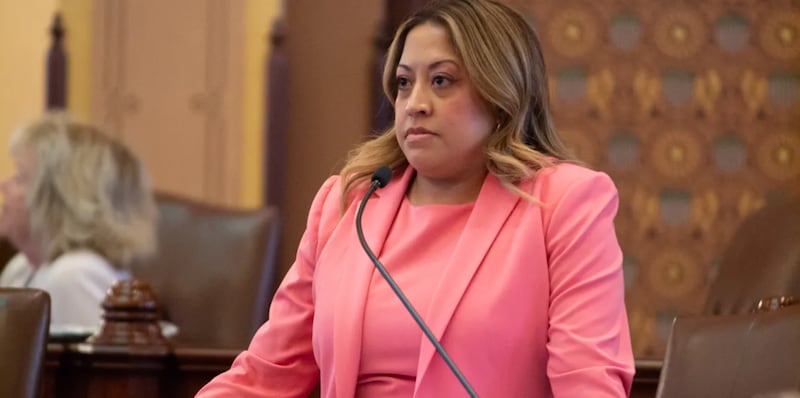
“The Senate has already voted on provisions of this bill several times,” Sen. Celina Villanueva, D-Chicago, the bill’s lead Senate sponsor, said on the Senate floor Thursday.
“We’re just trying to get it home in order to give us some more time to try to address the larger issue that was determined during the Tyler v. Hennepin (County) decision and to try to do it right and make sure that we’re keeping people in their homes,” Villaneuva added.
HB598 next goes to the governor’s desk.
Tyler v. Hennepin County
In the 2023 Tyler v. Hennepin County decision, the Supreme Court unanimously ruled that local and state governments cannot seize and sell the homes of people with unpaid property tax debt without returning the value left after the debt is settled.
Every state but Illinois has corrected their state law in accordance with the ruling.
To comply with the ruling, the state must require that homeowners receive the leftover funds from a sale after their debt has been settled.
Before the Tyler decision, county treasurers could hold annual sales of unpaid property tax debt to private investors. If the homeowners fell behind on paying back their debt, the investors could then seize and sell the property, pocketing the difference with no refund to the homeowner.
As a result of the seizure, homeowners would lose the entire value of their home, which is often much more than the size of their debt. The tax sales help local governments continue to fund their everyday operations, but critics say it also leaves homeowners vulnerable to predatory tax buyers.
Some groups would take advantage of a loophole in the law called sale-in-error that allowed them to receive a refund on a sale if there was an error in the sale documents, like miscalculated square footage.
That loophole has since been closed after a report from Cook County Treasurer Maria Pappas, but the state still needs to enact further reforms to the sale process to comply with the Tyler ruling.
“This isn’t a new issue, we’ve been working on it for years,” Villanueva said in a statement. “We cannot continue to let this issue fall by the wayside while families — especially seniors and working-class homeowners — remain at risk of losing not just their homes, but the equity they worked their entire lives to build.”
Legislators have introduced some reform bills, like House Bill 3146 and Villanueva’s Senate Bill 3940, but face resistance from the groups who buy tax debts.
Neither bill has passed out of committee, signaling that the legislation is still a way off from becoming law.
Capitol News Illinois is a nonprofit, nonpartisan news service that distributes state government coverage to hundreds of news outlets statewide. It is funded primarily by the Illinois Press Foundation and the Robert R. McCormick Foundation.