SPRINGFIELD — If the Democratic primary to replace retiring U.S. Sen. Dick Durbin has been the main event in Illinois politics over the past year, the Republican contest has largely played the undercard.
But, at least for one night, the race finally came under the bright lights.
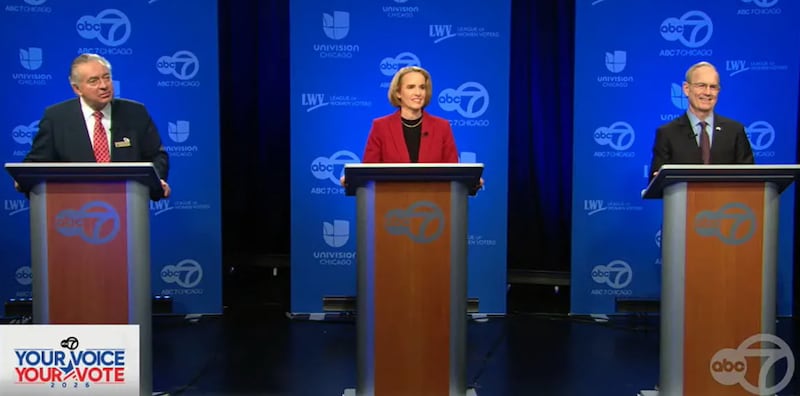
During an hourlong debate hosted by ABC-7 Chicago in partnership with Univision and the League of Women Voters on Wednesday evening, three candidates in the six-person field pitched themselves as best equipped to flip the seat red after more than four decades in Democratic hands.
The candidates — information technology professional Casey Chlebek, corporate attorney Jeannie Evans and former Illinois Republican Party Chairman Don Tracy — stopped short of criticizing President Donald Trump directly but registered their disagreement with his call to “nationalize” voting and to his approach to tariffs.
Experience or new face?
The last Republican to hold Illinois’ Class 2 U.S. Senate seat was Sen. Charles Percy, who served three terms until his defeat by then-Democratic U.S. Rep. Paul Simon in 1984. Simon was later succeeded by Durbin, who’s held the seat since 1997. Sen. Mark Kirk was the last Republican to represent Illinois in the upper chamber, serving a single term from 2011 to 2017 — and losing his reelection bid to now-U.S. Sen. Tammy Duckworth.
This year, the GOP race is wide open. A January poll found that 84% of primary voters were undecided. Tracy led the field with just 6% support while no other candidate registered more than 3% support.
Tracy, a Springfield attorney who served as party chair from 2021 to 2024, said the open contest presents a “terrific opportunity” for the GOP to win back a statewide office, but it “will not be easy” in a state that’s become safely Democratic in recent federal elections.
“It will be an uphill dog fight because the Democrats will have a lot more money than the Republican candidate,” Tracy, an unsuccessful 2010 GOP candidate for lieutenant governor, said. “And for that reason, it is certainly no job for a political novice.”
Tracy is mostly self-funding his campaign, having loaned himself $2 million in August. He had roughly the same amount on hand at the beginning of the year, according to federal campaign finance reports, placing him far above the other candidates in the race.
Evans, a Chicago attorney who specializes in anti-trust law, was his closest competitor, starting the year with nearly $300,000 on hand after raising more than $500,000, about 80% of it self-funded.
Chlebek, a native of Poland who immigrated to the United States as a teenager in the late 1960s, was an unsuccessful candidate for the GOP nominations for U.S. Senate in 2020 and 2022. He’s self-funded to the tune of about $100,000.
Unlike Tracy and Chlebek, Evans’ name has never appeared on the ballot before. She used that to cast herself as the “political outsider” in the race.
“It’s time for a fresh face of the Republican Party in Illinois,” Evans said. “I am ready to work hard to motivate people with conservative values across our entire state to come out to vote in November.”
The issues
None of the three candidates directly answered when asked to identify an area in which they disagreed with Trump, who has lost Illinois by double-digit margins in three consecutive elections. A recent poll placed Trump’s overall approval rating at just 39% in Illinois, though 84% of Republican voters approved of his job performance.
However, disagreements with the president emerged when specific topics came up.
Evans said tariffs imposed by Trump “achieved some good results” but acknowledged that she’s “a free market economist” who believes they should only be used in “specific situations or to achieve certain goals” in the short term.
Tracy said that the U.S. has “been subsidizing the world, including China and Europe, for way too long,” but that “the jury’s still out” on if Trump’s tariff regime will achieve its policy aims of more equitable trade deals and the onshoring of manufacturing jobs.
Chlebek said tariffs are “a tool” that shouldn’t be used “in an arbitrary fashion.”
A verdict is expected to be rendered soon by the U.S. Supreme Court on a lawsuit challenging Trump’s ability to impose tariffs without congressional approval.
All three said they would support a proposal that would require voters to present valid photo identification to vote but stopped short of supporting Trump’s recent call to nationalize elections, which are run by states under the U.S. Constitution.
“With 50 states, it’s hard to hack,” Tracy said.
Evans said she sees “some room for federal standards,” but supports states running their own elections.
Chlebek also stressed the importance of institutions like the United Nations and NATO that have come under attack by Trump and some Republicans in recent years.
“We have to be careful as far as removing our relationship with the rest of the world,” Chlebek said. “We have to make sure that international institutions are preserved because it serves our interests.”
Minimum wage, other topics
The federal minimum wage has been $7.25 per hour since 2009, while Illinois’ has been $15 for about a year. All three major Democratic candidates in the race have called for the federal wage to increase anywhere from $17 to $25.
But the Republicans said they are just fine leaving it as-is.
Tracy said he was concerned that a wage increase would impact employment opportunities for teenagers and developmentally disabled people.
“It’s the bottom rung of the success ladder and that’s why the focus is misplaced on the minimum wage,” Tracy said. “We need to be focusing on real wages.”
Tracy also said that new requirements for food assistance in the One Big Beautiful Bill Act signed by Trump last year were “long overdue,” citing “too many able-bodied Americans out of the labor force living off of welfare.”
Evans said she would propose “to peel back regulations and taxes that burden companies” instead of raising the price floor.
Evans and Tracy each said they would not support a national abortion ban and leave that decision to individual states. Chlebek did not answer the question. All support the U.S. staying in the UN and NATO.
Tracy said he supported Trump’s pardons of people convicted of crimes connected to the Jan. 6, 2021, attack on the U.S. Capitol, which disrupted the certification of Joe Biden’s 2020 Electoral College victory and resulted injuries to more than 100 police officers and extensive physical damage to the building. Evans sidestepped the question, saying “it’s 2026, I’m moving forward.” Chlebek said he did not support the pardons.
Chlebek, Evans and Tracy were chosen to participate based on factors such as fundraising and having a functioning campaign website. R. Cary Capparelli, Pamela Denise Long and Jimmy Lee Tillman II are seeking the Republican nomination for U.S. Senate. Early voting has commenced, and the primary election is March 17.
Capitol News Illinois is a nonprofit, nonpartisan news service that distributes state government coverage to hundreds of news outlets statewide. It is funded primarily by the Illinois Press Foundation and the Robert R. McCormick Foundation.