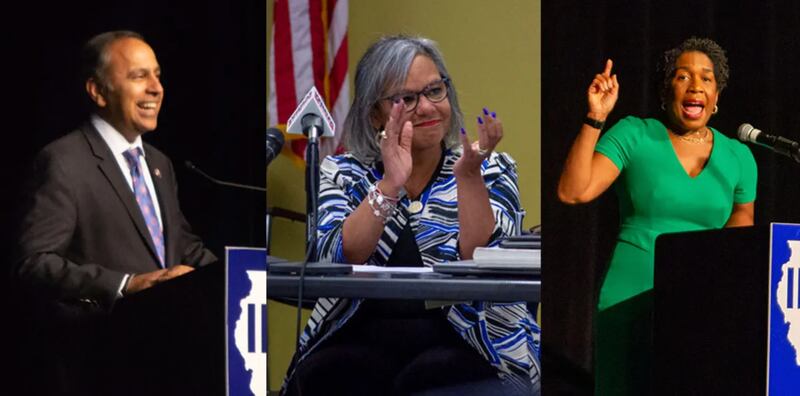
The top three Illinois Democrats vying for a seat in the U.S. Senate sought to position themselves as the best candidate to fight the Trump administration and restore trust in government Thursday night.
In an hour-long debate hosted by ABC-7 Chicago in partnership with Univision and the League of Women Voters, U.S. Rep. Raja Krishnamoorthi, U.S. Rep. Robin Kelly and Lt. Gov. Juliana Stratton pitched voters on how they will serve as a legislative check to President Donald Trump.
Thursday’s debate featured less sparring over immigration and campaign donations compared to the first debate held two days prior, as candidates were not given time to respond to attacks by their opponents.
Instead, the trio agreed that Trump’s second term has plunged America into a constitutional crisis.
“I don’t think anyone imagined that someone would take advantage and break the laws that he has been breaking,” Kelly said, arguing she’s already taking steps to fight back by filing articles of impeachment against Homeland Security Secretary Kristi Noem.
Krishnamoorthi, who holds a solid lead in fundraising and the polls, advocated for Congress to use its authority over government spending to block the president’s agenda by establishing conditions the executive branch must follow to spend money. He argued that would be an effective way to ensure the administration follows science-based vaccine policies, for example.
“I think that we have to block appropriations … and restrict money that’s spent at HHS (the U.S. Department of Health and Human Services) unless it’s spent in the right way, including in executing a well thought-out vaccine policy,” he said.
The Schaumburg Democrat also said he supports a series of ideas, including banning mid-decade redistricting and limiting the president’s power to levy tariffs and issue pardons.
Krishnamoorthi also committed to using the Senate’s “blue slip” process that allows senators to block nominees to federal judgeships in a senator’s home state.
Stratton called for reforming the U.S. Supreme Court, accusing the conservative-leaning body, which includes three justices appointed by Trump in his first term, of “rubber-stamping” his agenda. She said she supports enacting term limits for justices and expanding the size of the court.
A Chicagoan who has served as lieutenant governor since 2019, Stratton committed to opposing any nominees Trump makes to the Supreme Court or federal agencies.
Bringing Illinois to D.C.
Stratton pledged several times to implement some of Gov. JB Pritzker’s accomplishments at the federal level.
“We need to do what we’ve done here in Illinois over the past seven years in our administration,” she said. “We have made record investments in K-through-12 education and didn’t leave it there. We also invested in early childhood and made college more affordable.”
To improve voting accessibility, she added Congress should follow the state’s lead in expanding voting hours and mail-in voting options. But Kelly, who polls show is in a tight second-place race with Stratton, sought to give Stratton a reality check.
“Oftentimes what you can do in Illinois, a very blue state, you cannot do that nationwide,” Kelly said. “It just does not work like that. As I’ve often said, I’ve been in Congress 13 years, and only in the majority four years.”
Foreign policy
The candidates also shared some disagreements over the War Powers Resolution and when a president should have to come to Congress for permission to take military action abroad.
Kelly took an absolute stance.
“I think the president should have to receive our approval before he attacks any country or tries to take over any country, tries to buy a country, tries to take over a country, tries to kidnap any leader of a country,” she said. “I think that he needs to come to us first before he does anything that can put our country and our people in harm’s way.”
Stratton said she wants “to make sure that Congress has the appropriate ability to review, give authority, have oversight.”
Krishnamoorthi was willing to give the commander-in-chief more leeway.
“In the case of an emergency, the president should be able to act to defend the United States,” he said. “However, where there’s not an emergency, such as what we saw with Venezuela where he deployed armed forces in hostilities, he must come to Congress first.”
The candidates were also asked what Congress should do to ensure the U.S. stays engaged in global public policy after Trump has removed the United States from international treaties and collaboration on a variety of issues.
“We have to take care of and be a role model in our own country before we can tell other countries what to do,” Kelly said. “The other countries need to see that we care.”
Minimum wage
Stratton has carved out a bold lane in the race with her call to raise the minimum wage to $25 hourly. It has been $7.25 hourly since 2009 and $15 in Illinois for a little more than a year.
“I don’t think we should think about just minimum wage,” Stratton said. “I think we should think about a livable wage. What kind of income must people have so that they can put food on the table and maybe save a little extra money and maybe have something to spend in the small businesses in their communities.”
Stratton’s opponents were less aggressive, both saying they support raising the minimum wage to $17.
Krishnamoorthi said it “sounds reasonable given inflation,” but it must be done “in a way that also respects small businesses.”
Kelly again pushed back on the reality of Stratton’s idea making it through Congress.
Seventeen dollars is “what studies show is viable,” Kelly said. “And also, we have to be realistic about how much we want to raise it because we of course have to get 218 votes in the House and 60 votes in the Senate.”
The seven other Democratic candidates running for Senate include Steve Botsford, Sean Brown, Awisi Bustos, Jonathan Dean, Bryan Maxwell, Kevin Ryan and Christopher Swann.
There are six Republicans running for the office: Cary Capparelli, Casey Chlebek, Jeannie Evans, Pamela Denise Long, Jimmy Lee Tillman II and Don Tracy. They will meet for a debate on ABC-7 next month.
Early voting begins Feb. 5 and the primary election is March 17.
Capitol News Illinois is a nonprofit, nonpartisan news service that distributes state government coverage to hundreds of news outlets statewide. It is funded primarily by the Illinois Press Foundation and the Robert R. McCormick Foundation.
:quality(70)/author-service-images-prod-us-east-1.publishing.aws.arc.pub/shawmedia/f831fdce-695a-47fc-8b7b-234f336b1d8a.png)