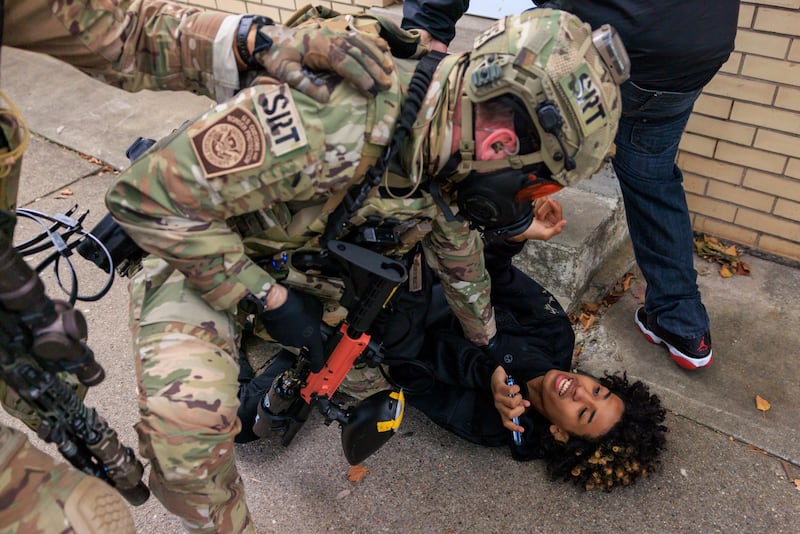
CHICAGO – A newly formed commission heard sobering testimony about federal agents’ excessive use of force, just days after Border Patrol chief Gregory Bovino was spotted back in the city.
The Illinois Accountability Commission held its first public meeting on Thursday in the city’s Little Village neighborhood to compile an official public record of misconduct by federal agents during the Trump administration’s “Operation Midway Blitz” immigration enforcement campaign this fall.
“The images are shocking and impossible to look away from, but most importantly, it’s going to be impossible to forget,” said Rubén Castillo, commission chair and former chief judge for the Northern District of Illinois. “This cannot be the new normal.”
The mandate for the commission set by Gov. JB Pritzker in an October executive order includes documenting abuses by federal agents and issuing recommendations for policy and legal actions.
Castillo said commission staff had already been busy reviewing evidence and vowed they would investigate “every single” allegation of abuse by U.S. Immigration and Customs Enforcement and other federal agents. Though it does not have the legal power to compel testimony or prosecute cases itself, the commission may recommend prosecution of agents accused of misconduct.
In January, the commission will open a portal where the public can submit information for review. The commission is required to issue a public status update by the end of January and a final report by the end of April.
Chemical weapons
During Thursday’s three-hour hearing, the commission listened to testimony from emergency medical physician and University of California-Berkley lecturer Rohini Haar, who reviewed 30-hours of public footage of federal agents’ use of chemical weapons, such as tear gas and pepper balls, against protesters, journalists and bystanders in the Chicago area.
Chemical weapons are only supposed to be used when there is a direct threat to public safety and no viable alternatives, Haar testified. When they are deployed, there are certain conditions and precautions that must be present to justify their use.
For example, precautions should be taken to ensure that children, elderly or other vulnerable populations are protected, warnings must be issued before use, and weapons should not be fired directly at people, especially toward necks and faces, or in enclosed spaces like cars.
“Chemical irritants are inherently indiscriminate,” Haar said. “Once you fire it, there is no saying where the wind blows or who it targets. So, you cannot control an individual with this, and you can’t target it.”
Bovino and others were the subjects of a slew of federal court hearings this fall, with Bovino at one point ordered to report to a federal judge daily until an appeals court issued a stay to that order.
Bovino and immigration agents left the city in mid-November for Charlotte, N.C., and other locations but recently were spotted back in Chicago.
While chemical agents are classified as “less lethal” weapons, they can have serious health effects, Haar testified. The canisters thrown can themselves cause blunt force trauma, while the chemicals they contain can cause a myriad of respiratory, skin, and eye injuries. In some cases, Haar said, use of chemical weapons has left people dead or with severe injuries. In many cases, people have long-lasting psychological trauma symptoms.
Upon review of the Chicago incidents, Haar said she saw cases of indiscriminate use of chemical weapons against children and the elderly, use in enclosed spaces, weapons fired without warning or attempts to address the situation with other tactics, such as communication.
“Every single case I’ve seen of this has been excessive use of force,” Haar testified.
Among the incidents the commission reviewed Thursday was federal agents’ use of pepper spray against a young family in a Sam’s Club parking lot. Rafael Veraza was driving when federal agents pepper sprayed him through the car window. The family’s 1-year-old daughter was in the back seat.
Matt DeMateo, a Little Village pastor at the New Life Community Church, found the Veraza family in the aftermath of the event. At the meeting, DeMateo shared videos taken by the family and his team, including of the young girl crying, her eyes red.
The scene, DeMateo said, felt like a ‘war zone’ with helicopters flying overhead.
“The whole thing is just line-by-line misuse of the irritants,” Haar said of the video, referencing the presence of a child, the deployment without warning in an enclosed space against people who were not a threat, and the spray being fired at Veraza’s face.
DeMateo also shared a video from earlier in the day, in which he witnessed Bovino brandishing a teargas canister with the pin pulled. DeMateo said he did not feel any threat from the public that justified such a use.
“The only threat I personally felt was from the agents,” DeMateo testified.
Investigating CPD, ISP
Over a dozen members of the public had signed up to give comments to the commission. Some thanked commissioners for their work and shared stories from community members who were unable to attend, either out of fear or due to detainment by federal immigration agents.
Others called on the commission to act swiftly, and to include Chicago and Illinois State Police in their review of local officers assisting federal immigration agents in violation of the TRUST Act.
“Our children’s lungs have been burning since September,” said Quinn Michaelis, a criminal defense attorney and the founder of the Edgewater Community Rapid Response Team, one of many rapid response networks responding to the presence of ICE in the city. “We cannot wait three more years for accountability. We cannot wait even until March.”
Presbyterian Rev. David Black, who was shot in the head with a pepper ball by federal agents while protesting at ICE’s Broadview detention facility on Sept. 19, also spoke at the meeting. Like others, he asked commissioners to recommend that the state drop its charges against Broadview protesters.
“We don’t just need calls for accountability. We need good neighbors, and we need those good neighbors to be protected by the state and the city that claim to have the same opponents we do,” Black said. “We need you to drop the state charges against those who are trying to protect their neighbors, instead of repressing the few people who are willing right now to step up and put their own lives at risk to stop these masked kidnappers.”
Castillo indicated that he and the rest of the commission would take the remarks under consideration.
“I heard on behalf of the commission loud and clear that ISP and CPD cannot be part of the problem,” Castillo said, prompting applause from the audience. “We will look at that issue in a very serious way, just like we will look at ICE.”
Capitol News Illinois is a nonprofit, nonpartisan news service that distributes state government coverage to hundreds of news outlets statewide. It is funded primarily by the Illinois Press Foundation and the Robert R. McCormick Foundation.