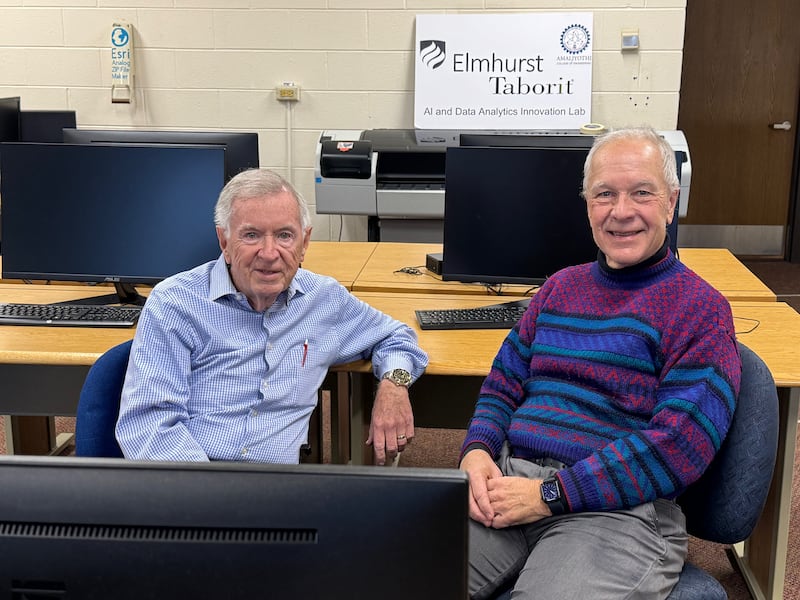
The idea for an AI tool to support young veterans began a couple of summers ago, when former Navy submarine veteran Patrick Yanahan stopped by Elmhurst University professor James Kulich’s office.
Carrying a canvas bag full of flyers he gathered at recent veterans’ events, Yanahan, a member of American Legion Post 80 in Downers Grove, dumped the bag onto Kulich’s table and said, “How is anybody supposed to make sense of any of this?”
Kulich told Yanahan he may have come at just the right moment.
It was just when AI and ChatGPT were gaining momentum, Kulich said.
“Even then, I was aware enough of what was possible,” said Kulich, who was professor emeritus and founding director of the master’s in data science program at Elmhurst University when he met Yanahan.
Over the next year, a team of students and professors at Elmhurst University and members of Downers Grove Post 80 diligently worked together through the complexities of creating an easy-to-use AI tool for veterans.
The Post 80 AI went live in November 2024 and now helps veterans access key information on education and funding options using advanced algorithms that provide tailored suggestions based on individual queries.
Yanahan, who served as the president of an international advertising and public relations firm, worked on internet-based projects for large companies during his career.
He now volunteers his time serving as marketing manager for the American Legion.
“Today, we are getting 400 visits a day,” he said about the AI tool’s success.
At the beginning of the project, he said, the post began brainstorming about how to serve younger veterans or “soon-to-be veterans.”
Through focus groups and a mail survey, the team learned what “hot button” issues are on the minds of new veterans.
“We found education and financing education were the bigger issues,” Yanahan said. “We thought it would be health care.”
The team also found that between government, university and trade school websites, the amount of data “was overwhelming.”
Utilizing artificial intelligence, Yanahan said, the team spent six months teaching the chatbot what they wanted it to do.
“As people come to (the system) and ask it questions, it starts remembering those and seeing patterns develop,” he said. “It is constantly updating itself with fresh information.”