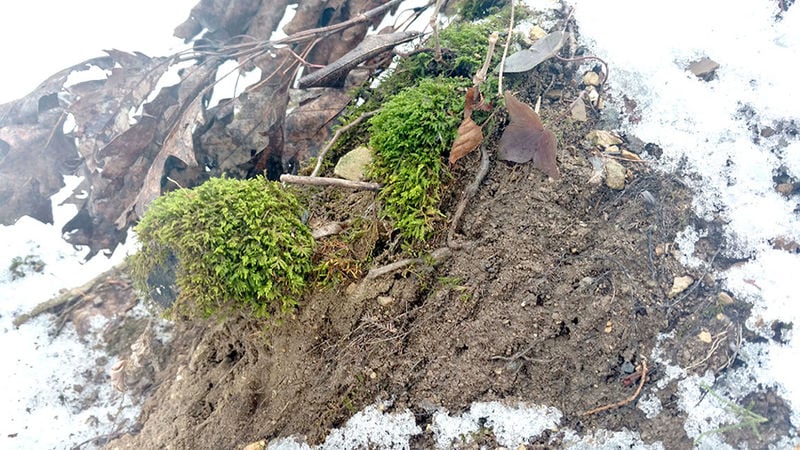
Mosses are incredible plants that come in a range of colors beyond just green and have diverse textures. There are over 13,000 species worldwide, with about 350 different species found in northern Illinois.
For a moss hunting adventure, try your backyard, the forest preserves or the Morton Arboretum. Good places to look are under trees on the north side, between paver stones, on old rooftops, and thinned out areas in lawns.
How does moss grow
Moss is one of the bryophytes, specifically phylum Bryophyta in the kingdom Plantae. These non-vascular plants are devoid of true flowers, leaves, stems, roots, or a system for vascular distribution of water and nutrients.
Mosses have phyllids, which are thin-celled leaf-like structures, and caulids, which resemble stems and are capable of photosynthesis and absorption of water and nutrients directly from their surroundings.
This is why high humidity and surface moisture are critical for the growth and reproduction of mosses. Since there are no flowers or seeds, they reproduce through a process where water on the plant carries the male cells to fertilize the female reproductive cells which become spore containing capsules.
After the capsules mature, they release their contents onto surrounding areas creating new moss plants. They have two growth patterns, cushions and carpets. With no true roots, mosses have rhizoids which are root-like structures that anchor moss to soil, rocks, and wood in shady, damp areas.
Moss environmental heroes
With a history exceeding 450 million years, this ancient plant prompts the question: how do they survive despite their seemingly fragile nature? Mosses exhibit greater hardiness than perceived, by adapting to varied soil types and thriving in conditions characterized by compaction, low fertility and poor drainage.
Their ability to tolerate periods of complete dehydration and rapidly rehydrate when moisture becomes available underscores their remarkable resilience in adverse conditions. Their durability has been demonstrated through their survival of space travel.
In 2022, mosses placed outside the International Space Station showed remarkable vitality, with most plants thriving upon their return to Earth. Besides being tough guys, mosses fulfill crucial ecological roles, including soil moisture and nutrient retention, erosion prevention, and providing habitat for various organisms and wildlife.
They also contribute to the nutrient cycle by breaking down organic matter. So, on your next walk see how many different types of mosses you can find.
References
Garden.org, Growing and Caring For Moss by William Moss. https://garden.org/learn/articles/view/4357/Growing-and-Caring-for-Moss/ (Accessed 27 February 2026)
University Maryland Extension. Moss In The Landscape. https://extension.umd.edu/resource/moss-landscape/ (Accessed 2 March 2026)
Popular Science. Moss survived 283 days in space, shocking biologists by Laura Baisas. Published Nov 20, 2025 https://www.popsci.com/science/space-moss/ (Accessed 21 February 2026) For more information, check out https://mortonarb.org/app/uploads/2023/03/Outstanding-Mosses-of-the-Arboretum-2023-Photo-Guide.pdf
Trica Barron-Boyd is a certified master gardener volunteer with University of Illinois Extension serving DuPage, Kane, and Kendall counties.