It’s that season when we see pinecones used as decorations everywhere. We spray them to look snow covered or give them bling with glitter, add them to crafts, wreaths, porch pots and our Christmas trees. But the pinecone is much more than a decoration.
The next time you go pinecone picking keep these fun facts in mind, as pinecones play an important part in nature and have a specific function in the plant world.
Not all cones are pinecones
Pinecones only come from pine trees, which are called conifers. Did you know that all pines are conifers, but not all conifers are pines?
It’s a confusing statement since when we look at an evergreen tree we tend to call them pine trees, right? After all, they all have needles and cones, but this is not the case.
The term “conifer” comes from the Latin word’s “con” meaning cone and “fer” meaning to carry, so conifers produce cones. To identify the difference let’s look at the needle arrangement and cone differences.
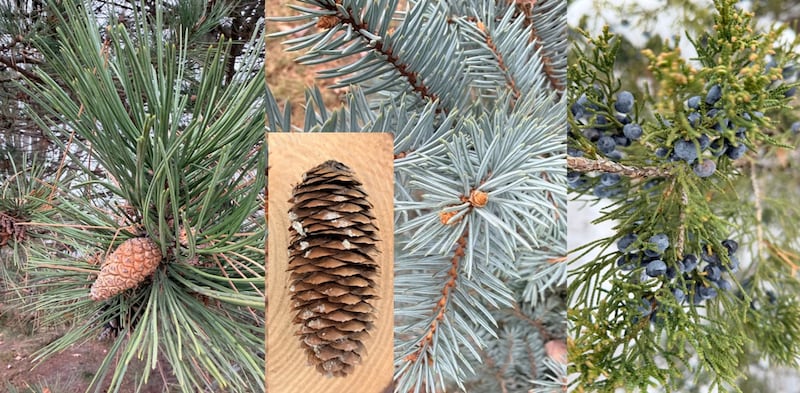
A pine like the Austrian pine has long, slender needles grouped in bundles of usually two needles per bundle and their cones are woody and rigid. They can be 3-4” and take up to two years to mature.
A conifer, like the blue spruce. has single needles, while other conifers like the juniper can have scale-like needles.
Spruce cones have thinner scales than pinecones, which gives them a more flexible feel.
What looks like a berry on a juniper is a fleshy, fruit-like cone that contains two to three seeds.
The wonders of pinecones
• The main function of a pinecone is to keep the tree’s seeds safe.
• Pinecones open and release their seeds in warm temperatures. The Jack pine has pinecones that rely on fire to open the tightly closed cones to release its seeds.
• Pinecones can let you know if humid, rainy or cold weather is coming! This is when they close their scales to protect the seeds.
• Some pinecones have staying power and can hold on to their branches for more than 10 years.
• Pine trees like the pinyon pine has cones that produce pine nuts which are not only for the wildlife but are great in salads too. You can try to grow and harvest pine nuts from a pinyon pine tree of your own, but it could take up to 15 years to mature.
• All pine trees produce male and female cones. The pinecones we see are only the female cones. The male cones are much smaller and are often overlooked.
• All conifers do have one thing in common, they attract wildlife! Birds and other wildlife eat seeds from the cones and use evergreen branches as cover from winter weather and predators.
Hopefully, these insights into pinecones have enlightened you on their many wonders. Happy decorating!
References
• University of Nebraska-Lincoln. School Of Natural Resources Regional & Community Forestry. Austrian Pine-Pinaceae Pinus Nigra. https://snr.unl.edu/data/trees/identification/basictree.aspx?sid=82 (Accessed 22 November 2025)
• NC State Extension North Carolina Master Gardener Toolbox. Picea pungens Blue Spruce, Colorado Spruce. https://plants.ces.ncsu.edu/plants/picea-pungens/ (Accessed 22 November 2025)
• NC State Extension North Carolina Master Gardener Toolbox. Juniperus communis var communis Common Juniper. https://plants.ces.ncsu.edu/plants/juniperus-communis-var-communis/ (Accessed 22 November 2025)
• Sandborn, Dixie. 2017. Michigan University MSU Extension. Fun Facts About Pine Cones. https://www.canr.msu.edu/news/fun_facts_about_pine_cones (Accessed 23 November 2025)
Trica Barron-Boyd is a certified master gardener volunteer with University of Illinois Extension serving DuPage, Kane, and Kendall counties.