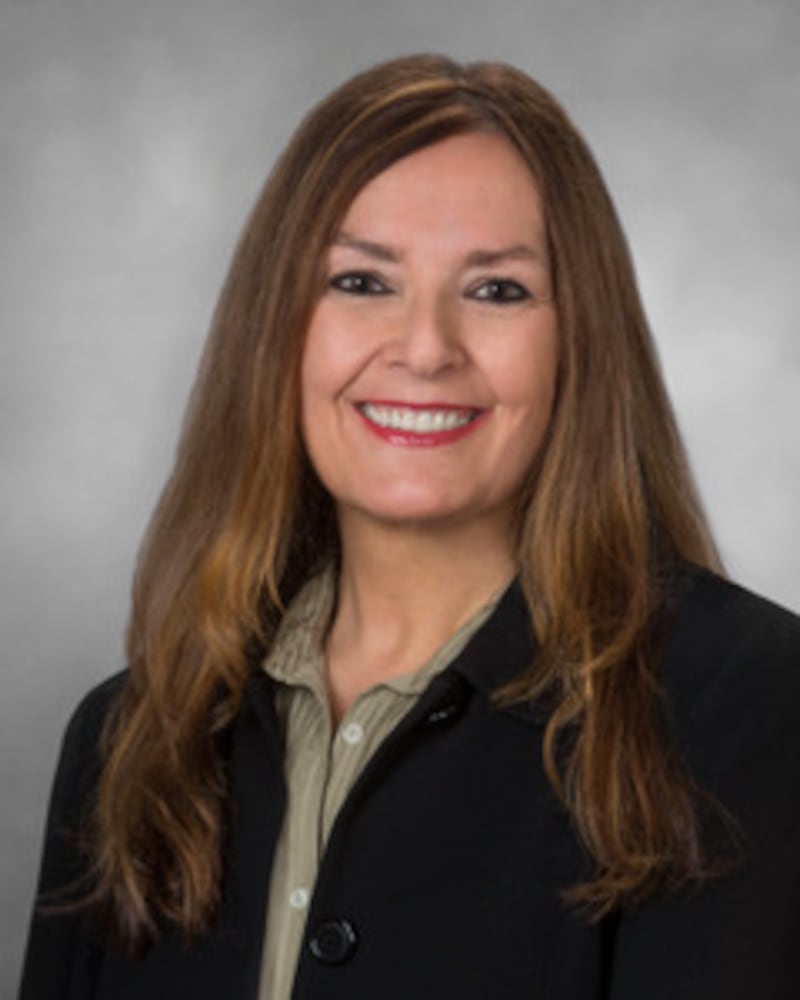
Name: Leslie Juby
What office are you seeking: Kane County Commissioner, District 11
What is your political party? Democrat
What is your current age? 64
Occupation and employer: Commissioner, Kane County Board, District 11
What offices, if any, have you previously held? Geneva CUSD Board of Education 2007-2011; 2013-2021, Kane County Board Commissioner District 11 2022- present
City: Geneva
Campaign website: www.Lesliejuby.com
Education: BA Language and Literature
Community involvement: Kane Excellence in Education Partnership, member Board of Directors Feb 2016- Present
Workgroup for Inclusion, Diversity, and Equity in the Children’s Mental Health Grant 2018-2022
Regional Board of School Trustees 2021-2022
Geneva Strategic Plan Advisory Committee 2011-2017
Illinois Mathematics and Science Academy, Board of Trustees
School Success Task Force, Governor’s Appointee
Truancy in Chicago Public Schools, Governor’s Appointee
Marital status/Immediate family: Married with two adult children
What are your top three priorities for this district?
Promoting economic growth
Expanding mental health services and diversion programs
Preserving our natural resources, open spaces, and farmland
Should the County Board regulate short-term rentals? If so, what regulations would you want to see?
Recognizing the need to establish standardized guidelines, the Board passed an ordinance at the January 2026 County Board meeting regulating short-term rentals. This process began several months prior when affected homeowners reached out with suggestions on how to address some negative behaviors that were happening at short term rental properties.
The new ordinance requires property owners to pay licensing fees; be compliant with health life safety standards, such as ingress/egress, fire detection systems, and insurance obligations; limit overnight human and animal occupancy (no more than two people to a bedroom with a cap on 16 guests regardless of number of bedrooms; no more than 3 dogs or cats); restricts parking and outside amenities such as mobile hot tubs or food trucks; prevents over saturation of short term rentals in neighborhoods. Additionally, the Board passed amendments to the Nuisance Ordinance regarding noise levels and trespassing, strengthening enforcement by the County and the Sheriff’s Office.
These ordinances are not intended to be static but a first attempt to address a growing problem in unincorporated Kane County. Some other factors that will need to be considered are: 1) the most appropriate way to lobby the Illinois General Assembly to change the municipal code to allow more stringent application fees (currently capped at $200/yr/property) 2) changing the County Zoning Code
3) assessing whether or not this income property should be treated like a business instead of a residence, and 4) determining the best way to enforce compliance that does not put the burden of reporting onto the homeowners in the neighborhoods.
How would you like to see the former Fabyan Parkway jail site redeveloped? Should all or part of the property be sold?
The former jail site, a 39.69 acre zoned rural residential property with frontage off Fabyan Parkway, is one of approximately 160 properties owned by Kane County. The Fabyan site was discussed in the Energy and Environment Committee as a possible location for a community solar field and then presented as information only during a Committee of the Whole, but future use has yet to be determined by the full commission.
In November of 2025, the Board received a Broker Opinion of Value on its potential redevelopment options for the Fabyan parcel. Potential property uses were residential, in-fill industrial development, and mix/special use. While not an exhaustive survey, no solar project was included by the real estate broker so solar was not mentioned in the Market Data Approach.
The County Board recently engaged in discussions regarding property disposition and is updating the purchasing ordinance to determine the best way to value land assets and the processes necessary to market unneeded or unwanted properties. The Fabyan property, along with the other 159, should be evaluated to determine its Highest and Best Use which could include selling the property to return it to the tax rolls, installing a solar field, potentially encumbering the property for 25-30 years, or waiting for a comprehensive study on all the properties before making a determination of best use. I do not believe that this is a time sensitive issue and do not support the Board rushing to a permanent decision based on the suggestions of one of the working committees.
Last year, the board was divided on a “We Stand Against Hate Week” proclamation. What is your view on it?
“We stand Against Hate” is a national movement in response to the uptick of hateful, divisive speech and the escalating violence that permeates our lives. While mostly symbolic, this proclamation affirms the County’s commitment to remain a safe and welcoming environment for all our residents by raising awareness and publicly denouncing injustice. I supported the proclamation, will continue to stand as an ally, and will work to guarantee our policies and procedures will not negatively impact our neighbors.
The Kane County Board has limited federal immigration enforcement on county property. Do you support that move? Do you support the Illinois TRUST Act more broadly and what, if any, reforms to it would you like to see?
On November 17, 2025, I voted to limit federal civil immigration enforcement activities on county owned parking lots, vacant lots, and garages. This simple vote “affirms that all people, regardless of immigration status, are entitled to dignity, due process, and equal protection under the United States Constitution” and re-affirms Kane County’s commitment to provide services in a fair, equitable, and culturally responsive manner. Additionally, this resolution asks the State of Illinois and the Federal government to do something to protect the rights of all people, as immigration policies are not under the jurisdiction of a county board.
Building trust between immigrant communities and law enforcement leads to safer neighborhoods and allows scarce resources to remain focused on local crime prevention and investigation. Any state legislation that modifies the TRUST Act should clearly define the rights and responsibilities of municipalities as they deal with immigration concerns in their communities, reiterate the differences between civil and criminal enforcement, and tighten up loopholes that allow for subjective interpretation of the Act.
Federal Immigration legislation must prioritize due process and human dignity, clearly define civil and criminal enforcement, and prevent any more weaponizing of government agencies against our residents.
The county board is expected to have another tight budget season this year. Looking ahead, if you must decide between raising the property tax levy or cutting programs, what would your choice be? What specific areas of spending would you prioritize cutting? How much further are you willing to dip into reserve funds to avoid program cuts? Do you support the diversion of RTA revenue from transportation to public safety?
The tax levy, tied to the Consumer Price Index for inflation, gives municipalities the ability to request a specific amount of property tax revenue to fund their essential services and operations. Kane County falls under the Property Tax Extension Limitation Law (PTELL) that caps the amount of revenue it can raise to the lesser of 5% or the CPI. The tax levy provides a reliable tool for determining future budgets and programs and is a fiscally responsible way to deliver the essential services our residents expect and develop long term financial health for the County.
As happened last budget cycle, each department and elected office will need to review their budgets, prioritize the highest need and reorganize and restructure as necessary. The adopted 2026 budget reflects an overall decrease in expenditures of approximately 9% ($13,985,952) with use of fund balance reserves dropping from $27.2M to $6.3M with no reduction in force or termination of essential services. I supported the one-time diversion of RTA revenue from transportation to the General Fund as a necessary step to prevent depleting safety net reserves. In October, 2025, the Board passed a Motor Fuel Tax increase, raising the four-cent tax to eight cents to permanently offset the dollar for dollar sweep. This tax increase will take effect July 1, 2026. I did not support this increase in October asthe gas tax is tied to inflation and continues to increase annually and disproportionately affects working families.
Along those lines, are you willing to consider other new revenue sources like asking voters again to approve a countywide safes tax increase or increasing the motor fuel tax?
As a non-home rule county, Kane can only raise additional taxes through increasing the tax levy, capturing new construction, raising the gas and grocery taxes or through referendum. As the County has increased the tax levy, captured new construction, raised the gas and grocery taxes, its other option to raise revenue is through referendum. It is important to allow the voters to decide if the county has made a viable case to raise more revenue.
One financial stressor is the end of COVID-19 relief dollars. What should the county do with programs funded by federal COVID-19 dollars?
Many county departments and elected offices depend upon grant dollars to finance their programs. It has always been the practice to view grant dollars as finite and therefore sunsetting the programs they fund when the dollars are depleted. Most grant funded programs have metrics and deliverables to determine the success of the programs. If a program is successful and delivers positive outcomes for the county, alternate forms of funding should be sought, whether it be different grant funds, special fund monies, or general fund expenditures.
What is your stance on solar energy facilities or data centers on agricultural land? Does the risk of lawsuits factor into your stance? What about battery storage?
The Illinois General Assembly recently passed the Clean and Reliability Grid Authority Act (SB25) that prevents counties and municipalities from adopting ordinances that prohibit solar or wind projects. This Act, which expands the Climate and Equitable Jobs Act is meant to move our dependence away from fossil fuels. While the Act also lifts bans on nuclear energy, allowing another renewable energy source, and defines an energy resource and procurement plan (battery storage), it also moves to create a one-size-fits-all set of state standards to apply to the siting of wind and solar fields. While it may initially seem prudent to apply a uniform set of standards when deciding on a new solar project, these standards do not recognize unique local ecological, geographical, or social contexts of each county. Kane County contains some of the most high-value, high-productivity farmland in Illinois with agriculture a prominent land use, contributing millions of dollars to the economy. By removing a municipality’s ability to determine the best use of its land, the statute may increase a series of unintended consequences that threaten not only the food supply, No Farms No Food, but also the fragile economy on which we depend. It is my hope that our legislators will allow us the discretion to determine what is best forourcounty and its residents.
The increased demand for data centers requires municipalities to carefully consider how such centers will fit into their long term planning. While the construction of data centers creates temporary large scale construction employment, they provide marginal permanent employment and are massive consumers of water and energy, threatening our limited water supply and overwhelming our power grid. Consideration of the data center’s ability to provide its own energy source should be prioritized, as should their water resource consumption plan.
Developing battery storage will be imperative to help supply energy that the uptick in data centers will require.