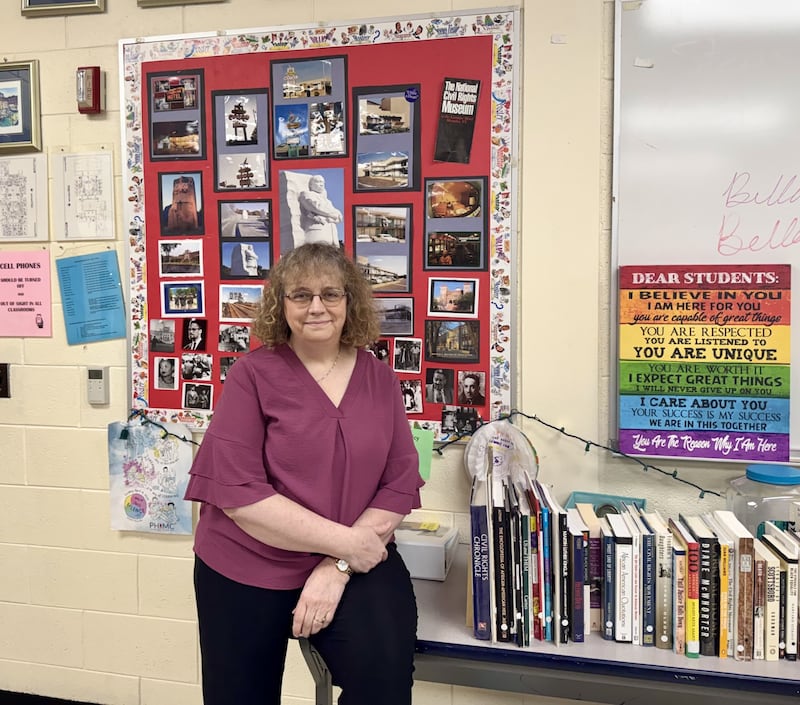
In Marilee Applebee’s Seneca High School classroom, books are more than assignments – they’re doorways. Students stand in a charged Salem courtroom as accusations fly, walk alongside Scout Finch as justice is tested and confront the unsettling world of book-burning firemen.
Applebee is retiring after 34 years at Seneca High School. In her final year, former students and colleagues are reflecting on how she transformed literature into lived experience – and created a classroom where every student felt safe to be themselves.
“When you’re teaching literature, you need to ground it in the time period either it was written in or set in,” Applebee said. “You want to make sure they understand the time period it was written in and the setting. So if you’re doing ‘The Crucible,’ you need to understand Puritanism, but you also have to understand McCarthyism because that’s what it was about.”
By weaving each work’s historical context into the lesson, Applebee transforms reading into a lived experience – helping students see not just what a text says, but why it matters long after the final page.
The daughter of two high school English teachers, Applebee grew up surrounded by books and a passion for teaching.
“I guess it’s in my blood,” she said, laughing. “When I was about 2, my parents put my crib up against a bookshelf and I just pulled the books into my crib. Like, I want to read these. It’s just one of those family stories.”
Applebee credits her parents for shaping both her teaching style and her approach to reaching students. She said she often hears them in her lesson plans and when she speaks to her students.
“Their love of books, their love of travel, their love of teaching — I’m really my parents’ kid in terms of where I ended up and what I teach,” she said.
This passion for justice, inherited from her parents, shapes every lesson she teaches. Her lesson plans combine her love of literature and history with her commitment to recognizing injustice.
When teaching “Fahrenheit 451,” she focuses on censorship. When teaching “Black Like Me,” the focus is on the Civil Rights Movement. She opens each unit by changing her bulletin board to represent the challenges presented in the text, then gathers students around it to begin the lesson.
“When I put up the next bulletin board – it’s all about books that have been challenged,” she said. “We talk about it: Have you read this book? What’s wrong with that book? And then I explain what people are saying about it.”
During her AP English class, Applebee taught “Night,” Elie Wiesel’s 1956 Holocaust memoir. Inspired by her mother, who also taught “Night” in her own class, Applebee realized she could create an entire literature course focused on the Holocaust.
“It just happened organically,” she said. “I don’t even know how many months of researching and pulling things together, until it became a semester class. I think it’s been about 15 years now.”
Once again, she focuses on what’s happening historically – and what’s happening now.
“It hurts me to see that we’re allowing it in this country and in other places in the world,” she said. “About 10 years ago, I started adding to my PowerPoint every single semester because there was more happening. And then Bondi Beach happened, and then they bombed a synagogue in Mississippi. It breaks my heart to see it happening.”
Applebee’s classroom became known as a haven for students struggling with their differences, an aspect of her room that she took very seriously.
“I think I grew into it,” she said. “I didn’t have a super liberal background or anything. But stepping up and caring for other people is what my parents did – doing extra things for kids.”
She recalled a pivotal moment early in her career, before the language of allyship became common.
“A young man came to my door one morning and said, ‘Mrs. Applebee, I just wanted to tell you that I figured out I’m gay,’” she said. “And I went, processing, processing... OK, thank you for sharing that.”
That moment stayed with her. Right before the Supreme Court made its decision on marriage equality in 2015, Applebee noticed a group of students who needed support. She worked with the school social worker at the time, Jill Rockrohr – now the director of Special Education – to create the Gay-Straight Alliance.
:quality(70)/cloudfront-us-east-1.images.arcpublishing.com/shawmedia/DJW7XPGTAFGUTH22X6IVVEPPQM.jpeg)
“I realized there was this new population that maybe didn’t feel safe, because I didn’t know how they felt,” she said. “I thought maybe someone just needed to stand up and say, ‘Hey, I’m an ally.’ I started to advocate and see who those kids were, and make sure that people in the school – administration, other teachers – knew that maybe we needed to do better and do more.”
Over her 34 years at Seneca, Applebee took 13 overseas trips with students, expanding their understanding of the world beyond the classroom. Her former students and colleagues have reached out to express their gratitude.
In a retirement Facebook message board, over 300 former students left comments reflecting on her impact. One wrote: “Thank you for being a teacher who always made each student feel accepted and cared for.”
Vicky Carathanassis, now a pastor, shared how Applebee’s impromptu speaking lessons shaped his career. “Impromptu speaking taught me to read the prompt, and the first idea that comes to your mind afterward is either your thesis, argument or conclusion,” he said in a message to the school. “I’ve done this with every paper I’ve written and every sermon I’ve preached, and it’s never failed me.”
On her last day at Seneca, Applebee’s classroom will be empty. But the books will remain, doorways to other times, other places, other lives. And somewhere, a student will open one and understand why it matters.
When asked how she wants to be remembered, Applebee was clear.
“I want to be remembered for showing the kids there is so much more to the world out there,” she said. “It’s so fun to go and experience it. And maybe just loving literature. I think you can tell the teachers that really love what they’re teaching, and I hope that came through.”