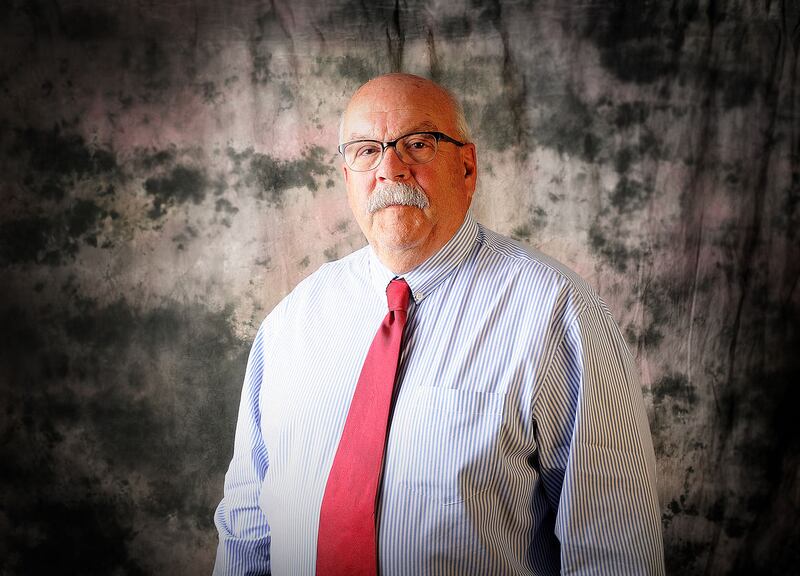
In his role as Kankakee County coroner, Bob Gessner is charged with the task of investigating death and the causes associated with it.
In 2012, he began to notice something alarming. The number of deaths caused by drug overdoses was on the uptick, as nine occurred that year. These deaths were most often linked to drugs classified as opioids, substances such as heroin, morphine, OxyContin and as of late, the particularly powerful fentanyl. At the time, not many people were familiar with the term.
Six years later, almost everyone knows what types of drugs belong to the opioid family, and with good reason. Kankakee County experienced a record number of deaths from overdoses in 2017, and there is no immediate sign of it slowing down.
"It hasn't peaked,'' Gessner said of the epidemic. "There are all these different kinds of fentanyl out there, and I see it getting worse before it gets better.''
But because of Gessner's determination to continue to fight an uphill battle that already has been waged for half a decade, he has been named a Daily Journal Citizen of the Year for 2017.
<strong>A crusade he takes personally</strong>
Gessner turned 70 earlier this month, and he has reached an age where many people are contemplating retirement if they haven't done so already.
You can't count him among them. Gessner already has declared he will run for re-election in 2020, when he will be 72. He has worked for the coroner's office in some capacity since 1984 and has held the top job since being appointed in 2003. Gessner has won election to four terms since — in 2004, 2008, 2012 and 2016.
Why does he continue to enjoy a job most people would consider very difficult because of its somber nature? Those who know him best can explain it.
"He's very passionate about his job and this issue (the drug epidemic),''' said Sherree Gessner, Bob's wife for the past 42 years. "He sees what these families go through. He sees it because he is a family man.''
Another member of Bob's and Sherree's immediate family is Chad Gessner, one of the couple's three adult children and a veteran lieutenant with the Kankakee County sheriff's police. A law enforcement job has allowed him an up close look at his father in action.
"Every death I've seen him work, through my profession, he has treated every family like his own,'' Chad said.
Jerry Huot, a close friend of Bob's for most of their lives, puts it this way:
"I don't think you can find a more caring, sympathetic and dedicated coroner in any other county in the country,'' Huot said. "The county does not know how fortunate it is.''
<strong>Current crisis heightens care level</strong>
By 2014, Gessner had become even more convinced that an opioid epidemic was upon us and took more direct steps to confront it. In 2015, he led the drive to establish the Kankakee County Narcan Program.
Narcan is an antidote which reserves the effect of an overdose when administered, and a proven way to save a person on the verge of death. Once the program was established, Gessner joined personnel from Riverside Healthcare to train local law enforcement on how to administer Narcan. To ensure everyone was trained, sessions were held as early as 5 a.m. and as late as 10 p.m.
"Bob sounded the alarm on the heroin epidemic in Kankakee County before it was an epidemic,'' said county state's attorney Jim Rowe, adding the Narcan training that was offered here later became commonplace across the state.
The training did not bring an immediate reduction in overdose deaths, however. Fifty-six people suffered overdose deaths in the county last year, the most since statistics were first tracked in 2010. In a per capita sense, the county averaged an alarming 51 deaths per 100,000 people, a rate so high, President Donald Trump recently mentioned Kankakee County when unveiling a new federal initiative to fight the drug scourge.
However, the coroner's office counts 27 saves made through Narcan administered by police throughout the county, and that number grows exponentially when you take into account saves made by first responders and at local hospitals. Gessner estimates first responders made more than 100 last year, and about 250 saves were made at the hospitals.
Gessner said he knows stopping the flow of drugs into the county can go a long way in helping curb the crisis. That's why when talking to family members of victims, he welcomes information that reveals who might have supplied the drugs. A name alone can't bring an arrest and conviction, but it begins the process of, perhaps, securing them later.
Another step in that direction occurred last year, when the state's attorney's office was awarded a $100,000 complex narcotics grant from the Illinois Criminal Justice Information Authority to fund a full-time complex narcotics prosecutor and a part-time complex narcotics investigator. Their main task is to pursue drug-induced homicide charges against dealers who supply drugs that lead to a user's death.
The grant, as well as the Narcan push, are initiatives that feature a display of cooperation among Gessner, a Republican, and Rowe, a Democrat. Both admit they have been questioned why they would work with someone from a rival political party, and both are quick to point out a united front is needed to fight the epidemic.
Gessner said: "People ask me, 'Why are you working with a Democrat?' He's not a 'D;' and I'm not an 'R.' He's the state's attorney; and I am the coroner.''
A big part of the job for Chad Gessner and the sheriff's police is to make these arrests, and the bond developed between his father and Rowe helps in the task.
"You see a Democrat and Republican working together, and I think that's what we need,'' Chad said.
Rowe wants that work to continue.
"I am happy he is going to continue,'' Rowe said. "I will cross party lines to support his re-election.''
<strong>Other duties still addressed</strong>
While he has placed much emphasis on the drug fight, Gessner still keenly attends to his other coroner duties.
He immediately goes to work at any hour of the day or night when he learns of a death of any kind, as Huot and Gessner's wife can attest.
"We've been playing golf in the middle of a tournament, and he'll get a call and say, 'I gotta go,'" Huot said. "One time, he got a call about a decomposed body in a rural area. I said, "Bobby, the body is decomposed, been dead for months, what difference is a few hours going to make? But he still left because that's how seriously he takes his job.''
Sherree and her husband often travel in separate vehicles to attend events, such as their grandchildren's sporting activities, because Bob occasionally gets called away. But, sometimes, when traveling in the same car, they have to leave together abruptly.
"There's been times we've had to leave the grocery store with the cart full because Bob gets a call,'' she said. "We apologize to the employees, but he can't wait.''
Gessner will show similar consideration to the employees who work with him in the coroner's office. Many have taken notice, including Deputy Coroner Eric Cavender, who wrote a glowing letter of recommendation for the Citizen of the Year honor on Gessner's behalf. The praise is deserved.
"He has a wonderful staff and encourages the family unit,'' Sherree said. "He takes the calls on holidays so the staff can spend the time with their families.''
Other crusades the coroner has embraced is the importance of road safety improvements, the use of seat belts and the need to refrain from both texting and drinking while driving. Gessner meets with students at local high schools, especially during prom season, to deliver these messages.
Speaking of deliveries, Gessner's career in public safety began as a member of the Kankakee Fire Department in 1969. He remained there for 30 years, and during that time, delivered 13 newborn babies. He also taught hundreds of paramedic students and mentored many new firemen before retiring from firefighting in 1999.
Gessner clearly has seen the worst life has to offer, but it has seemingly always brought out the best in him. His son said that is because of the personal values he holds and impresses upon others through example.
"He's just a genuinely nice, caring and loving individual,'' Chad said. "He treats other people the way he likes to be treated, and he taught that to my sister, my brother and me.''
<strong>Age:</strong> 70
<strong>Profession:</strong> Kankakee County Coroner
<strong>Residence:</strong> Limestone Township
<strong>Family:</strong> Gessner and his wife, Sherree, have been married 42 years. They have two adults sons, Chad (wife Nicole) and Scott (wife Kim), and one adult daughter, Jennifer (husband Justin Kokas). They also have seven grandchildren, four boys and three girls.
<strong>What's next? </strong>Gessner has immediate plans to push for more education to combat the opioid epidemic and also to establish more local facilities where addicts can go for help. He also plans to run for re-election to a fifth term in office in 2020.