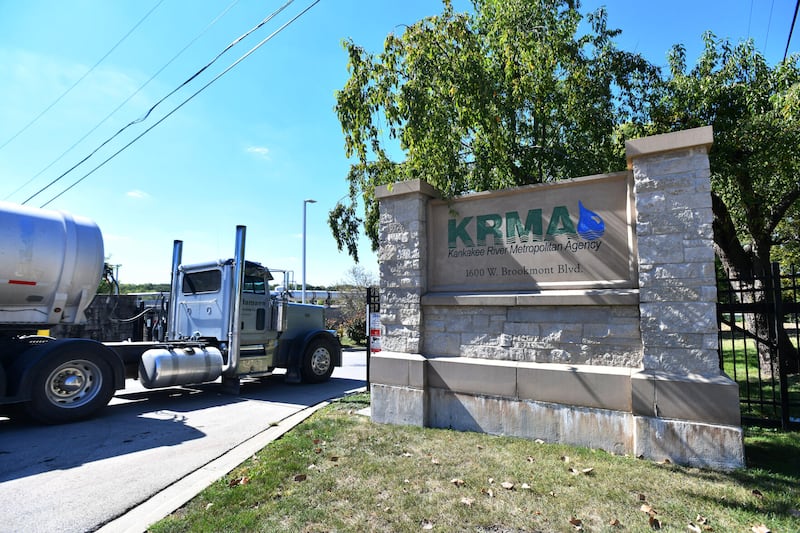
The Kankakee-based wastewater treatment plant has begun beating the bushes in terms of increasing the amount of imported liquid waste to the plant.
At last week’s Kankakee Regional Metropolitan Agency board meeting, the seven-member board was updated on the recent trend of declining hauled-in waste, which, of course, results in shrinking wastewater treatment revenues.
If these numbers continue the downward trend, the result could mean upward adjustments in the amount charged to all users within the plant’s network of local communities.
On the flip side of this issue, however, at least one board member said the drop in hauled-in waste does have another effect: the need for a significant plant expansion could be put to rest.
Bradley Mayor Mike Watson, who filled the village’s vacancy for last week’s meeting as the regular board member, village financial director Rob Romo, was on vacation, has rarely been pleased with the KRMA system in terms of its function and cost.
He said less hauled-in waste would mean the need for increased capacity would be reduced.
The plant has a per-day wastewater treatment capacity of 25 million gallons. The plant currently treats on a daily basis some 13 million gallons.
The daily process is somewhat thrown out of balance due to the issue of some industry waste coming into the plant that has had no pre-treatment. This lack of pre-treatment situation means those gallons take longer to process, which reduces the available volume.
Dave Tyson, KRMA executive director, said Watson was partially correct regarding the treatment needs for some hauled-in waste. However, he noted, upcoming tighter Illinois Environmental Protection Agency regulations will require some future upgrades.
The loss of hauled-in waste would affect the plant’s revenues.
While the agency budgets $100,000 monthly for hauled-in wastewater revenue, it is failing to hit this mark in recent months. In February, for example, Tyson noted only $54,349 was realized.
With the budget year nearing its end on April 30, Tyson noted this line item is down $470,000 from last year.
Regardless of that discussion, the plant is set to begin in September an $8.2-million upgrade, Tyson said. The planned 18- to 24-month project is not about capacity or hauled-in waste, but rather replacing or overhauling equipment.
KRMA’s governing board is comprised of representatives from Kankakee, Bradley, Bourbonnais and Aroma Park. Kankakee holds four of the board’s seven seats.
Tyson explained KRMA’s incoming waste has declined about 500,000 gallons per month, which results in shrinking revenue. Based on its current intake, Tyson estimated the plant could lose treatment opportunities for 1 million to 1.6 million gallons yearly.
There is no one single reason for the drop in wastewater, he explained. He said the loss of the Gilster-Mary Lee, the Momence-based chocolate factory, which was destroyed by fire in February 2025, is one reason.
The Chester, Ill.-based company declined to rebuild the Momence factory, resulting in the monthly loss of some 100,000 gallons of wastewater treatment revenue.
He also noted Waste Management-affiliated sewage treatment plants in the Chicago suburban region also have led to declining KRMA processing.
Regarding the trucked-in wastewater, Tyson noted staff is reaching out to recruit new accounts. The process has only just started, so it may be a few months before new customers are found.
Tyson noted management is casting a net to potential clients within a 60-mile radius of the plant at the end of West Broadway Street.
:quality(70)/author-service-images-prod-us-east-1.publishing.aws.arc.pub/shawmedia/dfb924db-1795-46ea-afb4-ba3c95e55c46.jpg)