Editor’s note: This article commemorates the 175th anniversary of Shaw Local in 2026.
While researching the early years of The Telegraph, founded in 1851, I found this fascinating story. Its details are literally “shocking,” and they illustrate how life was so different back then.
The first fatal accident ever reported in The Telegraph appeared in its 13th issue, on Wednesday, July 23, 1851. Charles Fisk, the editor and founder of The Telegraph, penned the article, titled “Mournful Occurrence.”
Struck by lightning
On Friday morning, July 18, “Miss Charlotte Means, a young daughter of Mr. and Mrs. John Means, residing two miles from this village, was instantly killed by lightning.”
Other sources mentioned that John L. Means brought his large family of at least 10 children to Dixon from Ireland around 1845. They lived on a farm just east of town on the road to Franklin Grove, near today’s airport.
Charlotte, 16, was described as “a beautiful girl who was soon to have been married.” On that fateful Friday, she “had risen in her usual good health and vigor and was attending to domestic affairs.”
The fatal fluid
While a summer thunderstorm raged outside, Charlotte walked by a stove pipe attached to her home’s chimney flue. Suddenly, with a deafening crash, “she was struck by the fatal fluid.”
At the time, people often called lightning “the fatal fluid.” Lightning was “fatal” because it was deadly. As a mysterious “fluid,” it terrorized people with its unpredictable flow.
Charlotte died instantly. Her mother, nearby, was also struck by the bolt. She revived but “with much difficulty.” Even five days later, her mother was “still feeble and unable to be out.”
Lightning rod scams
In the 1850s, especially in frontier northern Illinois, houses were not built according to standardized building codes. Lightning rods were often an add-on feature sold by traveling salesmen. As The Telegraph reported in 1852, some salesmen sold lightning rods that were cheaply made and “worthless.”
Lightning occasionally struck local buildings. A resulting fire often destroyed the structure. Unless a building was erected with a way to channel lightning safely into the ground, people who were even inside the building were not safe from “the fatal fluid.”
Packed funeral
The young Charlotte was “much beloved by all her acquaintances.” News of her tragic end spread quickly from house to house in this small frontier town.
Dixon’s residents were then almost entirely located on the south side of the river. The village’s population encompassed about 1,000 people, less than a tenth of its size today.
Charlotte’s funeral was held on Saturday, July 19, the day after her death. Yet, even with such short notice, the funeral site could not hold the mourners and friends.
The occasion likely took place in Dixon’s simple 20-by-40-foot community meeting house, located about a block west of Oakwood Cemetery.
‘Be ye also ready’
Fisk, The Telegraph editor who was also a Presbyterian minister, reported that the funeral sermon was preached from the King James Version of Matthew 24:44: “Be ye also ready, for in such an hour as ye think not, the Son of Man cometh.”
This Scripture text must have been familiar to many. Living at a time when lives were often cut short by disease, illness, and sketchy medical knowledge, the nearness of death was a constant companion.
The editor’s poem
In Fisk’s July 23 article, he published a “hastily, but affectionately addressed” poem to the family.
“Bereaved friends, your loss ye deeply feel –
Sad, bow your hearts before the Sovereign Will,
Thy Charlotte, late so fair and blooming, dies,
And now beneath the silent turf she lies!
“Her sprightly form, no longer will you see;
Her late-filled chair will henceforth vacant be,
Her cheerful voice will greet your ears no more,
‘Tis still in death – her earthly course is o’er.
“Well may you grieve, to drink this bitter cup,
Yet sorrow not as those who have no hope –
Remember while with grief your bosoms swell
God gives the cup and doeth all things well.”
The lonely grave
Immediately after the funeral, a massive crowd accompanied the family in the sad march to Oakwood Cemetery, only a block away. “Seldom have we seen so large a funeral procession as followed her remains to the grave,” reported Fisk in The Telegraph.
In 1851 the cemetery was quite small, with only a few dozen graves near Fourth and Dement. Charlotte was buried in a small plot only 150 feet from Dement Avenue.
The rest of her family died many years later. By then, they had acquired their own cemetery plots elsewhere.
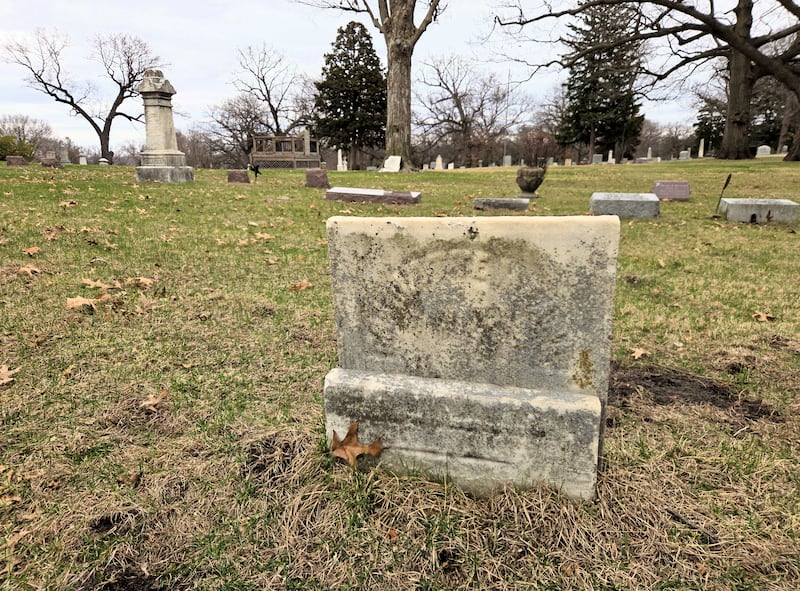
Today, 175 years later, Charlotte’s lonely, weathered gravestone is barely legible. It stands alone, surrounded by no family members.
Her sad story provides a snapshot of the realities of living on the frontier in Dixon in 1851.
- Dixon native Tom Wadsworth, PhD, is an author, speaker and occasional historian. His popular new book, “Distinctive Dixon: Fascinating Stories of Dixon’s Rich History”, is available at Books on First in Dixon.