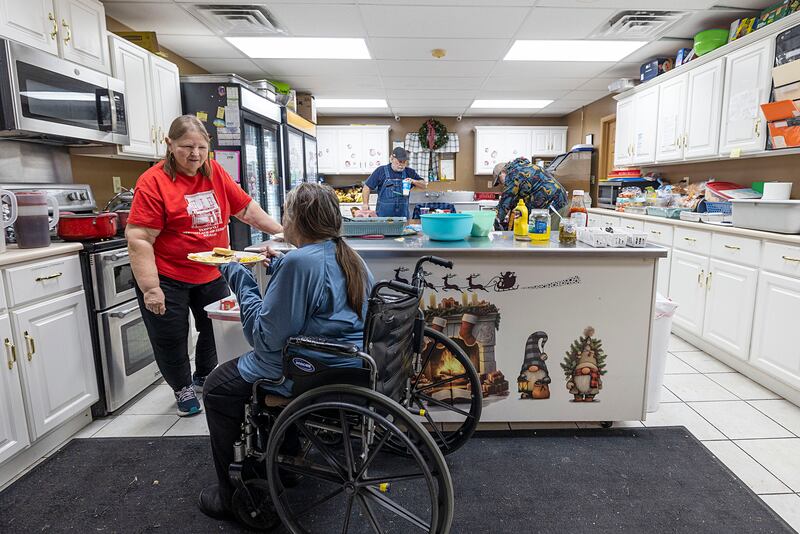
You walk into a living room furnished with a sofa and several comfortable-looking chairs.
A bookcase holds a variety of hardback and paperback books. Lamps on side tables add light. Pictures and paintings adorn the walls. The TV is on, with those in the living room watching an episode of a favorite TV series.
Someone sips a mug of hot cocoa and someone else is snacking on a donut.
“When it comes down to it, we look like your average, three-bedroom ranch house,” Myles Newberry, the director of the Twin Cities Homeless Shelter, said.
:quality(70)/cloudfront-us-east-1.images.arcpublishing.com/shawmedia/QK5KRN2SMNA27GBZNEKLU6CMVE.jpg)
:quality(70):focal(922x681:932x691)/cloudfront-us-east-1.images.arcpublishing.com/shawmedia/NJVZIRWFMFAZBCXC42WUPJMJMY.jpg)
:quality(70)/cloudfront-us-east-1.images.arcpublishing.com/shawmedia/5HA6XZ5T6FCH7JPPIV23I7FACE.jpg)
:quality(70)/cloudfront-us-east-1.images.arcpublishing.com/shawmedia/R27CNGZQTNCO3LPN2YXZXCDMVA.jpg)
:quality(70)/cloudfront-us-east-1.images.arcpublishing.com/shawmedia/FVLC2LPBXNDYRAHJY4QESRNLBI.jpg)
:quality(70)/cloudfront-us-east-1.images.arcpublishing.com/shawmedia/EPMLZ2WDSVGI7CDXLOCRRT47GM.jpg)
Newberry said the first thing that first-time visitors to the 32-bed shelter, located on the outskirts of Sterling, are surprised by is its size, both inside and out. The second is that the Twin Cities Homeless Shelter looks like what it is, a home, even if only temporary.
“I think people may think that homeless shelters are old houses that should be condemned or that they are more of an institutional-type place,” he said.
While the appearance of the Twin Cities Homeless Shelter could be a single-family home, the face of homelessness has been changing over recent years, creating challenges in capacity and care for Newberry and his two-person staff.
“The simple problem of homelessness, of someone being down on their luck and needing a place to stay, those people are few and far between,” Newberry said.
Mental health issues with would-be residents have increased in recent years.
“We are seeing more and more mental health issues. I get regular calls from mental health facilities throughout the state wanting to send us people,” Newberry said.
The challenges posed by residents with mental health issues aren’t simple, and there are no easy solutions.
“We are seeing some severe cases of mental illness. The way that the system is set up, it is very hard to get a person in to get help unless that person will cooperate. And they hardly ever cooperate. You can say it’s the shelter’s fault or the fault of the police or the discharging facility’s fault. The fact is that all of us have our hands tied because unless the individual asks for it, we can’t help them,” Newberry said.
The increase in residents and would-be residents with serious mental health issues led the shelter to install a panic button to summon police in an emergency.
Another increasing challenge for the shelter is posed by illegal drug use.
“Drug use is something else that, all of a sudden, we are having to deal with. We have never had to deal with it like we have been dealing with it,” Newberry said.
Methamphetamine is the main problem, but Newberry said concerns about fentanyl use and possession continue to surface.
One demographic challenge is the increase in the number of elderly people who are homeless. That poses several concerns for the shelter, primarily from a medical standpoint.
“The newest thing we are seeing is this huge increase in elderly unhoused, and that has me concerned. In many of these cases, they have medical issues, and we are not a medical facility. They may be on medications, and we cannot dispense medication. They may be suffering from schizophrenia or dementia and all the things that plague us as we get older,” he said.
Another ongoing battle is countering the stigma surrounding homelessness. With the increase in social media, Newberry said the amount of online misinformation and disinformation about those who are homeless and about the shelter itself has grown.
“Ninety-nine percent of what is said is positive, but there are a handful of people who don’t know what goes on out here and what we do, but they think they are experts about what goes on at a shelter,” Newberry said.
Newberry and the board and staff continue on in the mission started over 35 years ago by a handful of area churches.
“All the downtown churches saw a need. They got together, and each church would take it in turn to be the shelter for the night. We ended up in the location downtown. We outgrew that and then we ended up out here. It was just a group of people who saw a need and tried to do something about it, and that is who we have always been,” Newberry said.
:quality(70)/s3.amazonaws.com/arc-authors/shawmedia/45a20eef-b8d1-4d42-b8b1-b5f9fb81a1b3.png)