A nine-year-old photo of a smiling family wearing Cubs shirts when they gathered to watch their favorite team win the World Series.
A photo of a father reading to his 2- and 3-year-old daughters; another of him riding a bicycle while pulling a cart with the girls inside. A video of that same father with one of his daughters, together sending a message to a loved one.
Those memories of Sterling Fire Lt. Garrett Ramos were displayed on a projection screen and viewed by a Whiteside County jury Monday, Nov. 10. It was the sixth day of a civil trial in which the jury will decide if Rock Falls fire officials are to blame for Ramos’ December 2021 line-of-duty death while fighting a fire at 10031 Ridge Road, Rock Falls.
Ramos, 38, died after he fell through a burning floor and into a basement that fire officials overseeing the blaze didn’t know existed until it was too late.
His wife, Brittney C. Ramos, filed a wrongful death lawsuit in December 2022 against the city of Rock Falls; then-Rock Falls Fire Chief Cris Bouwens and Fire Chief Ken Wolf, who was the accountability officer at the scene and is now Rock Falls’ fire chief.
Brittney Ramos is claiming that the two fire officials’ willful and wanton disregard caused her husband’s death. She is seeking damages for herself and two young daughters, which attorneys say could reach into the tens of millions of dollars.
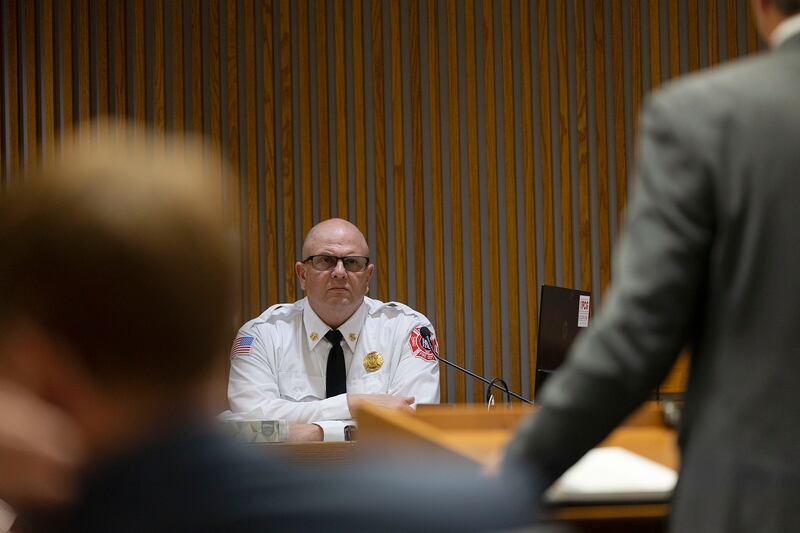
Wolf, who took the stand at 9 a.m. Monday, answered questions from Ramos’ attorney, Michael Gallagher, and defense attorney Michael Kujawa, who is representing Bouwens, Wolf, and the city of Rock Falls, which is also named a defendant in the lawsuit.
During his four hours on the stand, Wolf answered questions about training protocol at the Rock Falls Fire Department, which he joined as a firefighter in 1998.
Gallagher’s line of questioning focused on that training, which lays out the steps to be taken when a mayday is called and how firefighters are to be accounted for at a fire scene.
Wolf testified that when he became deputy chief in 2021, he also became training officer, the first time one had been appointed in the department. He then implemented more structured training, but he agreed that more training on mayday calls and personal accountability reporting should have been done.
Wolf said he believed the earlier training had lacked structure and agreed with Gallagher’s assertion that the department had only trained on mayday calls and personal accountability reporting, also known as PAR, five times over the first 23 years he had been on the department.
“Was there enough training for mayday and PAR?” Gallagher asked.
“Not soon enough,” Wolf responded.
Gallagher also asked if inadequate training contributed to Ramos’ death that night.
“It contributed, yes,” Wolf replied.
That line of questioning was used by Gallagher to lead into questioning about the fire scene itself, one that Wolf described as “chaos”.
Wolf served as the accountability officer at the fire, which had been called in at 11:04 p.m. Dec. 3 by a basement resident at the home.
Gallagher and his team throughout the trial have worked to prove that a string of errors on the part of Bouwens and Wolf led to the death of Ramos, whose body was recovered from the home at 1:13 a.m. Dec. 4, more than an hour after he issued two maydays while in the home’s basement.
Included in the list of errors, according to Gallagher:
• Bouwens not asking the resident who called in the fire if the home had a basement. By not asking if there was a basement and not determining there was one, fire officials were putting firefighters in harm’s way.
• Fire officials learned upon arriving at the scene that all residents were safely out of the home. When the home had burned to the point of being unsalvageable, command should have pulled firefighters from the interior of the burning home and changed the firefighter strategy from offensive to defensive, Gallagher said. Fire investigator Wendy Sanders’ expert testimony on Friday indicated no one should have been in the home after 11:25 p.m., about 21 minutes after the fire was called in.
• The fire was reported to be under control over the radio, when at the same time, the floor over the basement was developing holes. Firefighters were still in the home. This was at 11:54 p.m. At about the same time, a Christmas tree in the living room disappears, leading firefighters outside to believe it fell through a hole in the floor.
• The PAR should have been called immediately after the first mayday was heard at 12:03 a.m. to make sure all firefighters were accounted for. After the mayday call was heard on the radio twice in 60 seconds, it took fire officials 4 minutes to call PAR, according to a video played for the jury.
• A firefighter they thought was missing was quickly deemed safe; however, no one asked the firefighter who was found if he was the one who called mayday.
• Wolf was working the accountability board, which had five firefighters listed as being in the burning home at the time of the mayday call. Through hearing communication on the radio, Wolf determined four firefighters were accounted for, but overlooked Ramos as being on that board. Wolf testified that this happened because firefighters are normally tracked by their engine company as they work in their groups; this fire was different because firefighters split up to work with other companies, he said. He started following names instead of companies to try to keep it straight.
• Gallagher said Bouwens, who was incident commander, was not communicating with command staff or firefighters, nor was communication being effectively forwarded to Wolf, who was tracking firefighters from about 150 feet away.
Speaking further about communication at the scene, Gallagher asked Wolf if he would agree that the events described were “no way to run a fire.”
“I would agree that is not the most efficient way to run a fire,” Wolf responded.
“We’re not talking about efficiency here, chief, we’re talking about someone’s life,” Gallagher responded.
After Wolf’s testimony concluded, Garrett Ramos’ parents, Jeannie and Ed, testified about their son’s life and the impact of his loss. Ed Ramos was a Sterling firefighter from 1983 to 2013. Garrett joined the department in 2012, which put them in the firehouse working together for one year.
Jeannie testified about how her son was a friend to everyone and made everyone he talked to feel important. She talked about the strength she prays for each day to move forward.
Ed, also crying throughout the testimony, spoke about the impact on Garrett and Brittney’s two daughters, who are now 6 and 7, and the toll the loss has taken on Brittney.
He recalled how their last night spent together as a family was just hours before the fire, when Sterling was having a Christmas Walk and Garrett was working. Knowing there were treats at the station. Garrett’s parents, Brittney, and the two girls visited Garrett there. Ed recalled the family leaving the station at the end of the night.
“I said goodbye to him and said I loved him,” he said. “That would be the last time I saw him.”
“The world lost a great man,” he said.
Testimony will continue on Wednesday. The trial is expected to continue through the end of the week.
:quality(70)/s3.amazonaws.com/arc-authors/shawmedia/9bb5f897-be4a-42b8-9507-9193a7f43c2d.png)