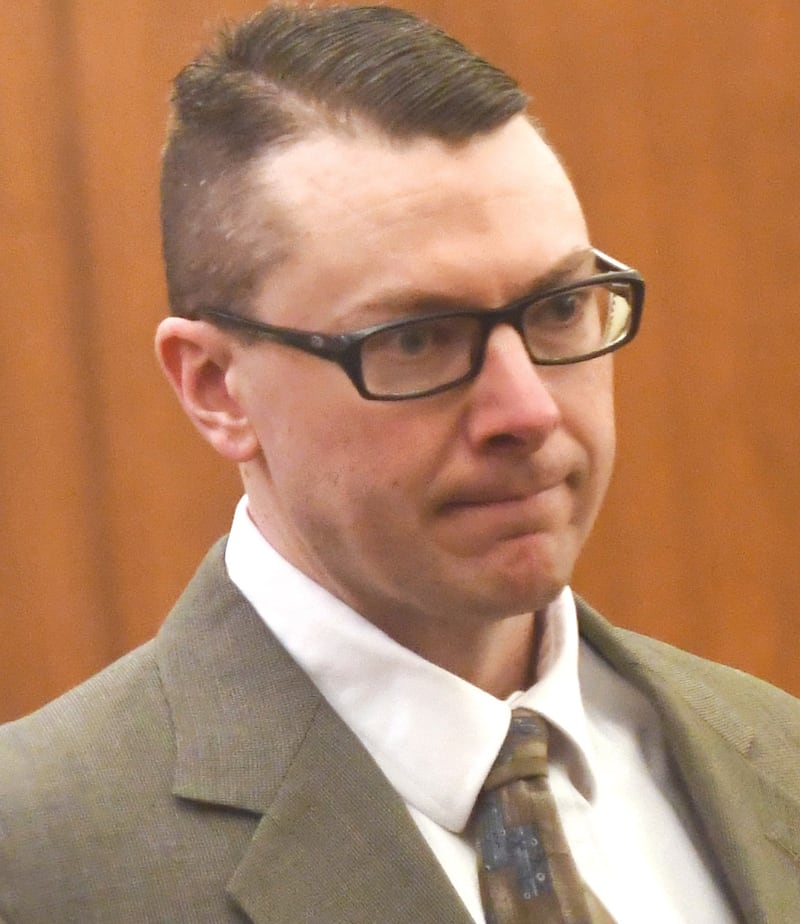
Testimony is scheduled to begin Tuesday, Jan. 13, in the trial of a Stillman Valley man charged with killing his ex-wife in 2016 and setting her Byron home on fire with their 3-year-old son inside.
Duane Meyer, 43, is charged with four counts of first-degree murder, two counts of aggravated arson and one count of concealment of a homicidal death in connection with an Oct. 19, 2016, Byron house fire in which his ex-wife, Margaret “Maggie” (Rosko) Meyer, 31, was found dead.
The couple’s 3-year-old son, Amos Meyer, who was in an upstairs bedroom in the home at the time of the fire, was later pronounced dead at a Rockford hospital.
Meyer has pleaded not guilty to all of the charges and has been held in the Ogle County Jail since his arrest Oct. 9, 2019.
A 12th juror was selected around noon Monday after a new panel of potential jurors was summoned to appear at the Ogle County Judicial Center in Oregon. Jury selection was paused Thursday when court officials had gone through two panels of potential jurors and there were no more potential jurors left to question..
Jury selection began Monday morning and continued to 5 p.m., with four alternate jurors also selected for the trial that is expected to last 3-4 weeks.
Before the start of Monday’s jury selection, Ogle County Judge John “Ben” Roe denied a defense motion by Meyer’s attorneys Christopher DeRango and Patrick Moore for a change of venue and mistrial based on the difficulty of securing a jury.
Ogle County State’s Attorney Mike Rock and his assistants, Matthew Leisten and Allison Huntley, argued against the motion.
Roe has admonished the selected jurors not to research or discuss the case with anyone, and to avoid media coverage and social media sites and comments about the case while they are serving as jurors.
In January 2025, DeRango filed a motion to move the trial out of Ogle County, just three weeks before the jury trial was scheduled to start Feb. 3. That motion was denied in April.
A change-of-venue motion typically asks the judge to move the trial to a different location. Those motions usually cite reasons that the filing party believes would prevent a fair trial in the county in which the case was filed. Pretrial publicity often is listed as a reason for a change of venue.
During the jury selection process, Roe, along with defense and prosecution attorneys, asked potential jurors a series of questions to determine each juror’s suitability to serve.
Roe excused the majority of potential jurors for a variety of reasons, including economic and employment hardships with the length of the trial, personal issues, health issues and predisposition as to the trial’s outcome.
The defense and prosecution had a limited number of excusals at their disposal.
Attorneys had previously agreed to select four alternate jurors in addition to the 12-member jury due to the expected length of the trial.
In the event one of the 12 jurors cannot continue to serve during the course of the trial, an alternate would replace them.
Alternate jurors listen to all the testimony and arguments made during the trial but are excused from deliberations if they are not seated as one of the 12. In previous hearings, attorneys have said cellphone records and data will be part of the evidence presented.
Maggie Meyer was a teacher at the Chana Education Center at the time of her death. She filed for divorce in 2014, and court records show the divorce was finalized in September 2016.
Prosecutors have argued that their evidence will show Duane Meyer planned to end Maggie Meyer’s life.
The defense has argued that text messages sent by Duane Meyer before the deaths were only part of a “contentious” divorce and not indicative of anything nefarious.
:quality(70)/author-service-images-prod-us-east-1.publishing.aws.arc.pub/shawmedia/c70d24f0-1332-4244-8446-e91288029474.jpg)