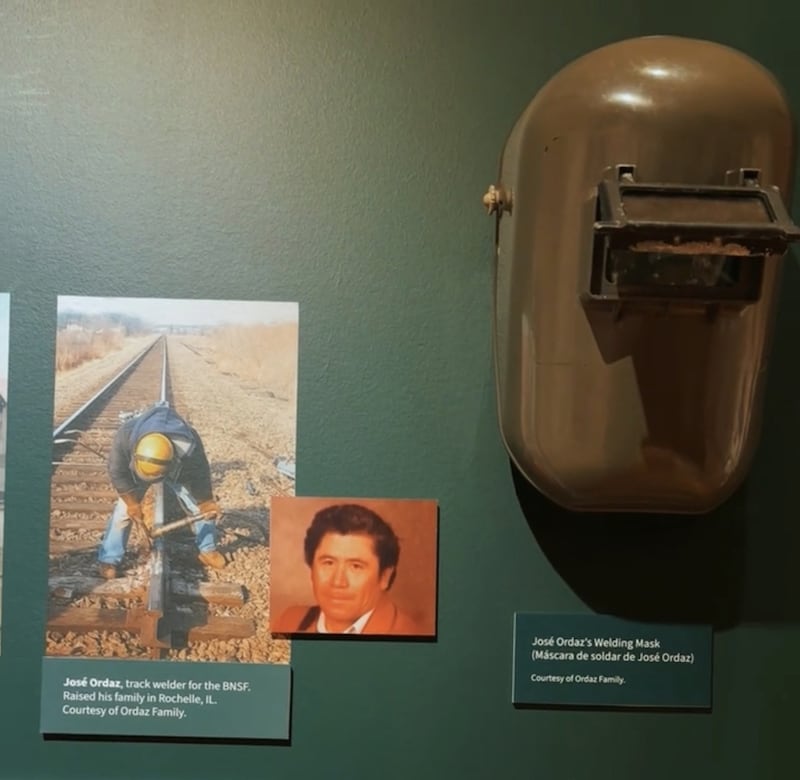
José “Carlos” Ordaz, a longtime Rochelle resident and Burlington Northern Santa Fe Railway worker of 30 years, was recently featured along with Rochelle in the Rieles y Raíces exhibit at the National Museum of Mexican Art in Chicago.
The exhibit highlights the contributions of Mexican and Mexican immigrant railroad workers throughout Chicago and the Midwest. Rieles y Raíces (tracks and roots), curated by Ismael Cuevas, M.A., and Alejandro Benavides, Ph.D., shares the history of Mexican and Mexican-American traqueros (railroad workers) through community stories and archival research, highlighting the communities they created along the very tracks they maintained.
Ordaz’s story, photos and items were submitted to the exhibit by his granddaughter, Paola Huerta. Ordaz, who died in 2024, worked for BNSF from 1974-2004 as a laborer, grinder and welder.
“It was a very big part of our family,” Huerta said. “I remember being little and seeing him leave with his uniform on with his lunchbox. My aunt and grandmother remember him being called into work in the middle of the night. He was always on call. It was very nice to see him recognized. We saw his old coworkers recognized as well. It was cool to see all of those people honored and recognized, as they should be.”
Ordaz was born Nov. 4, 1940 in Rancho Grande, Zacatecas, Mexico. He married his wife, Gloria, on Oct. 21, 1971 and they had five children: Jesús, Rosa, Debora, Lorena and Carla.
In 1972, Ordaz emigrated from Zacatecas to El Paso, Texas. There he heard that there were opportunities in the railroad industry. So he traveled north to Illinois. He arrived in Rochelle in 1973. He worked at Caron International and Del Monte Foods before starting at BNSF.
Ordaz began as a laborer, advanced to grinder, and eventually became a welder, which he did until his retirement.
“Though Burlington Northern often recognized its employees with anniversary gifts such as gold-filled Cross Pen sets, Red Wing boots, and commemorative rings, José also faced the painful reality of racism and isolation,” his submission to the museum exhibit said. “As one of the few Mexican workers in both the company and the town of Rochelle, he endured harassment severe enough to affect his health and force him to switch work teams. Out of fear of losing his job, he never reported the discrimination.”
Huerta said her grandfather channeled the struggles he saw on the job into perseverance and proving himself. To his daughters and grandchildren, he would often say, “Tienes que ser mejor que el mejor, y aún más mejor que eso”, meaning “You have to be better than the best, and even better than that.”
When Ordaz’s final day at BNSF arrived after three decades of service, the company marked his retirement with nothing more than a box of doughnuts. On his walk home that day, he removed his safety helmet and lunch box and hurled them down the tracks.
In his later years, José often joked about how much water he had to drink while working on the railroads. Because of the extreme heat and conditions, he’d often have to drink a gallon or more of water each day. So, when his family would encourage him to drink water in his retirement, he would stubbornly refuse, saying he’d already had enough water for a lifetime, now he deserved a can of pop instead.
Huerta said if her grandfather was here today, he would’ve enjoyed seeing his name in the exhibit.
“He always had so many stories of the railroad and BNSF,” Huerta said. “He would’ve loved to go to the exhibit and answer questions and tell his stories about what he used to do.”
The Rieles y Raíces exhibit has started a new archive of Mexican and Mexican American railway workers. Huerta said the amount of submissions that were seen shows how much history there is. The Rochelle area had very few Mexican families when Ordaz came to work there in 1973.
Ordaz was a well-known member of the community and St. Patrick’s Church. Along with his family, he loved music, dancing, food, sweet treats, and horses. Huerta said when her grandmother saw the museum exhibit, she was amazed.
“She didn’t think there would be any sort of gallery for something like that,” Huerta said. “It brought tears to her eyes and happiness that her husband was featured in a museum. It warmed her heart.”
Huerta wants to see more representation of people like her grandfather for the work that they did.
“Our family is so proud to see him recognized,” Huerta said. “Especially with how the political climate is around immigration now, something positive like that is amazing to see. Having him be a part of the exhibit leaves behind a legacy of resilience, strength and love. That work was a big part of his life. His story stands as a testament to the sacrifice and spirit of Mexican workers who helped build and maintain railways across the Midwest.”