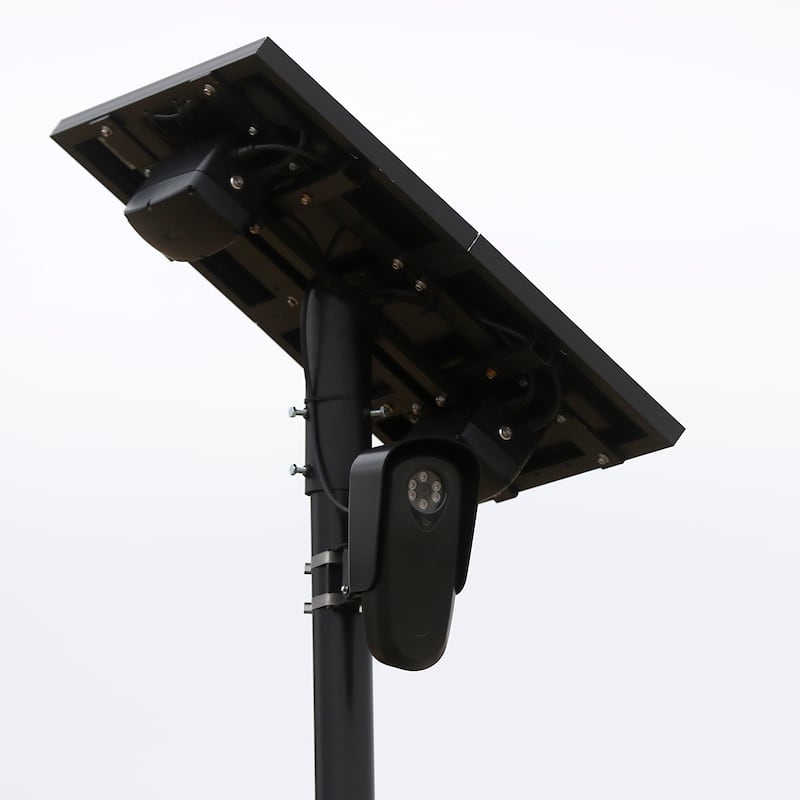
A bill proposed in the Illinois state legislature would limit when police agencies can access data created by automated license plate reader systems and how long the data would be retained.
House Bill 5151, known as the Automated License Plate Recognition System Act, would define when automated license plate recognition systems, sometimes called ALPRS, can be used by law enforcement agencies.
State Rep Jeff Keicher, R-Sycamore, wrote that he believes police groups are “strongly opposed to” the proposed bill because of how the technology has helped police work.
“License plate readers are a valuable public safety tool that have helped solve serious crimes across our state,” Keicher wrote. “In DeKalb County alone, this technology has helped lead to arrests in cases involving robbery, shoplifting, and an abusive father who killed his infant child. It is a critical resource for keeping our communities safe.”
The legislation would sharply limit how long police can keep data collected by automated license plate reader cameras and restrict how the information can be used, including banning its use to track people attending protests, seeking lawful health care or for immigration enforcement. The proposal has ignited a broader debate in Illinois over balancing public safety with growing concerns about AI-driven surveillance and personal privacy.
DeKalb County Sheriff Andy Sullivan said license plate readers were used during a multiagency search that spawned after sheriff’s deputies found Holly and Gary Schmidt dead inside their Sycamore home Sept. 30, the victims of apparent blunt force trauma.
An ALPRS in Rockford helped police find a vehicle that was missing from the scene, Sullivan said. As a result, Kevin Schmidt – Gary and Holly’s son – who police say later confessed to plotting the killings, was apprehended by the Winnebago County Sheriff’s Office within three hours of DeKalb County sheriff’s deputies first entering the Schmidt home.
Staff for state Rep. Kelly M. Cassidy, D-Chicago, who introduced the bill on Feb. 10, and state Rep. Nicolle Grasse, D-Arlington Heights, who sponsored the bill, did not respond with answers to Shaw Local’s questions by press time.
A staff worker for state Rep. Amy Briel, D-DeKalb, said Briel had no comment on the bill because it isn’t expected to be passed during the current legislative session.
If the bill were to be passed by the General Assembly, ALPRS data could still be used by police investigating violent crimes, missing person cases, hit-and-run crashes and stolen vehicles. The legislation would limit law enforcement’s access to the data, however.
If the data collected by an ALPRS isn’t associated with an investigation, court order or criminal case within three days, it’s expected to be deleted, according to the bill.
“We need to stop handcuffing officers and making it easier for dangerous criminals to escape justice,” Keicher wrote. “Illinois should be focused on policies that prioritize public safety and hold criminals accountable.”
A spokesperson for state Rep. Suzanne Ness, D-Crystal Lake, said Ness did not indicate she explicitly opposes the bill. But the bill has not yet had an opportunity to be heard by a committee or the full body.
“Our law enforcement agencies statewide wake up every day to serve and protect Illinoisans. The experiences they face daily, the tough responsibilities and the indescribable encounters are proof that these invaluable men and women have enough on their plate,” said Ness, who represents the 66th District that includes parts of Kane and McHenry counties. “With that said, monitoring Americans for non-criminal purposes takes these officers away from their ability to react and respond to real criminals and real crime here in Illinois.”
In January, Khadine Bennett, the advocacy and intergovernmental affairs director for the American Civil Liberties Union of Illinois, told Shaw Local that she’s an advocate for a three-day retention period.
The bill also would prevent data collected by ALPRS from being used to monitor, track, investigate or detain people who engage in political protests and community gatherings or are seeking lawful healthcare. The proposed law also would prohibit the data from being used for any immigration enforcement purposes.
The Automated License Plate Recognition System Act was filed at a time of growing resentment against AI-based surveillance, like what is used by an ALPRS. Officials in Dane County, Wisconsin, pulled funding from contracts with Flock Safety – the largest automated license plate reader system in the nation – in May.
Over in Sterling, resident concerns over Flock Safety cameras, what they record and who has access to that footage, also continue.
Jeff Gale, a Sterling resident, first spoke at a February Sterling City Council meeting to bring up his concerns with Flock Safety cameras positioned around the city.
At that meeting, Gale said he attempted to get access to his own information recorded by Flock Safety cameras in Sterling via a Freedom of Information Act request. Gale said he was told he could only obtain his own information if he was the victim of a crime.
At the May 18 meeting, Gale, who said he was part of the committee who helped choose the park equipment for the new Northwestern Steel and Wire Park on Sterling’s riverfront, said he visited the park recently.
“I am one of the people most excited for the opening of this park. But this morning, when I was down there, I was horrified to see a Flock camera that is located near the new park and not just a Flock camera but their newest, most powerful Condor camera. These cameras use AI features to automatically zoom and can capture audio,” Gale said.
“Are we, the citizens, expected to sit and wait until our data is exposed for real change to happen?” Gale said.
In June 2025, state Sen. Rachel Ventura, D-Joliet, and others joined Illinois Secretary of State Alexi Giannoulias in condemning the use of ALPRS by the state of Texas to track a woman who traveled to Illinois to seek abortion services not allowed in Texas. According to Giannoulias’ office, more than 83,000 cameras were used to track the woman.
The Associated Press reported that Mount Prospect authorities shared license-plate data with the sheriff in Johnson County, Texas, who was looking for a woman whose family was worried because she had undergone a self-administered abortion.
State Rep. Martin McLaughlin, R-Barrington Hills, whose district spans parts of Lake, Cook, Kane and McHenry counties, said the public safety benefits far outweigh the “subsets” being politicized during the current election season.
If these were such important issues – tracking undocumented citizens and women coming to Illinois to obtain medical services banned in other states “We could have done it last year when it wasn’t election season,” said McLaughlin, who served two terms as mayor of Barrington Hills (2013 through 2021) and was in office when Flock cameras were installed there.
“These subsets of potential use are all political, and general public safety should not be a political issue,” he said.
McLaughlin said cameras are essential tools in investigating residential break-ins and car theft rings, and that Illinois already has some of the strictest restrictions surrounding the use of the cameras, such as their use of facial recognition.
Cameras are “a force multiplier for police protection,” providing an additional 15 to 20 eyes monitoring cameras and keeping communities safe, he said.
Keicher said he thinks state Democratic legislators “are attempting to place new restrictions on this technology to push a political agenda.”
He thinks the bill would “make it harder for police to do their jobs.”
“We need to stop handcuffing officers and making it easier for dangerous criminals to escape justice. Illinois should be focused on policies that prioritize public safety and hold criminals accountable.”
:quality(70)/author-service-images-prod-us-east-1.publishing.aws.arc.pub/shawmedia/114d2561-d902-4313-913c-3ed613087b49.png)
:quality(70)/s3.amazonaws.com/arc-authors/shawmedia/45a20eef-b8d1-4d42-b8b1-b5f9fb81a1b3.png)