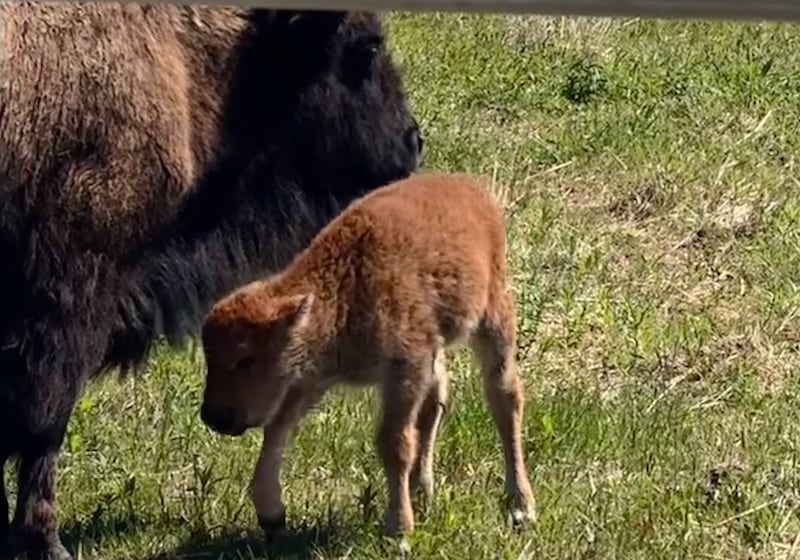
Huddled close to its mother, the first bison calf born in a Kane County tallgrass prairie in over 200 years represents more than restoration: Something lost. Something returned. Something reborn.
The American Indian Center calls it “rematriation.” The spirit of the phrase is the guiding force behind the bison reintroduction program at Burlington Prairie Forest Preserve, in partnership with the Forest Preserve District of Kane County. The preserve is on the DeKalb County line northeast of Sycamore.
Given how central rematriation is to American Indian identity, it’s only fitting the new calf, also called a “red dog” for its cinnamon-tinged fur, was born on May 9, one day before Mother’s Day.
Rematriation is “the act of returning the sacred to the mother.” Beginning among Indigenous women activists, the movement grew to encompass restoring relationships between indigenous peoples and their relatives and by reclaiming cultural and spiritual practices and stolen ancestral lands and artifacts.
The American Indian Center calls rematriation “a broader healing,” an equilibrium restored with Mother Earth and the matrilineal systems that connected generations of Indigenous peoples with the ecosystems that sustained their lives.
:quality(70)/cloudfront-us-east-1.images.arcpublishing.com/shawmedia/SXN7YSZIBJCNRGHY3CCV3ALAZM.png)
The new calf brings the Burlington bison herd to a total of seven. The herd was reintroduced last December. The gates to the preserve were fully opened to the public May 1.
“It is one thing to talk about restoring relationships with land and relatives, it is another thing to see new life come from that work,” Jay Young, co-executive director of the American Indian Center said in a post. “For Chicago’s Native community, especially our young people, this birth gives us a chance to know bison not just as something from history, but as living relatives on the land.”
Within their 32-acre enclosure, the three female and three male bison, along with the newborn calf, tread across painstakingly restored tallgrass prairie brought back to life by conservation volunteers and workers often seeding plants by hand.
:quality(70)/cloudfront-us-east-1.images.arcpublishing.com/shawmedia/3TMDUNM2RBG6XLXMY3SBM7HFVA.png)
The land echoes the golden sea that once blanketed the state before ecological destruction, beginning during the industrial revolution, uprooted the tallgrass prairie to less than one-tenth of 1% of its original expanse.
Young said reclaiming responsibility, and inspiring the next generation, “is about Native people helping shape what care looks like on this land.”
The American Indian Center called bison “relatives, providers and teachers,” their presence “connected to stories of survival, removal, resistance and return.”
“The near destruction of bison is inseparable from the history of harm done to Native nations, foodways and land-based lifeways,” the American Indian Center posted. The rematriation work “is rooted in that understanding and the center’s relationship, care and responsibility.”
Young said the calf’s birth represents living history, providing an educational opportunity to restore both land and relationships.
“Living in an urban area, it’s rare to stand on open prairie, feel the earth move, or be close to bison relatives in a way that reflects our teachings,” Young previously said. “Bringing them home opens a doorway for our community to remember who we are and to rebuild connections that history tried to sever.”
The American Indian Center will begin offering educational programming this summer for Native community members, youth and families to visit the site, learn from the land and deepen their relationship with the bison.
The programming pairs with the Chicago-based center’s focus on building opportunities to broaden the understanding of wellness as connected to land, culture, food, identity and relationship.
The center is partnering with the forest preserve district to create conservation educational opportunities, including a program where community scientists can help monitor prairie health, track changes over time and help take care of the vital ecosystem.
:quality(70)/cloudfront-us-east-1.images.arcpublishing.com/shawmedia/YJ7PCRN245FCVPS773WQRUTEJI.png)
Forest Preserve programming
The educational opportunities are part of the forest preserve district’s larger “Bison On the Landscape Series,” designed to highlight bison as the keystone species of the tallgrass prairie and the diverse and interconnected ecosystem of animals and plants that make the Illinois prairie so unique. Register at kaneforest.activityreg.com/selectActivity. Among upcoming events include:
- Birds and Bison, June 5: Join district naturalists for a guided bird-watching walk, as they discuss the various ways bison promote healthy habitat for grassland birds.
- Red Dog Days, June 14: Join district naturalists for a walk around the prairie in search of bison on a summer afternoon. Learn how they help the prairies and the animals that live there and possibly spot a “red dog” calf.
- Bison in the Prairie State, Aug. 13: A naturalist-led program on how human and non-human interactions have shaped the prairie landscape over the last 200 years. Explore different prairie ecosystems, looking for glimpses of one of the largest players in the prairie ecology narrative — the American Bison.
- Bison Days at Burlington Prairie, Aug. 22: Join district naturalists and the American Indian Center to experience the prairie through the lens of culture, ecology and kinship with indigenous bison. This immersive program features indigenous storytelling, guided exploration and opportunities to learn how bison shape the land and support thriving prairie ecosystems.
- Ethnobotany with the Bison, Aug. 23: Join district naturalists for an exploration of the tallgrass prairie. They’ll discuss how bison shape the landscape and how people have long relied on prairie plants for food, medicine and daily life.
:quality(70)/s3.amazonaws.com/arc-authors/shawmedia/0cef0bf9-a04e-4bb4-aea0-03d8ced01c00.jpg)