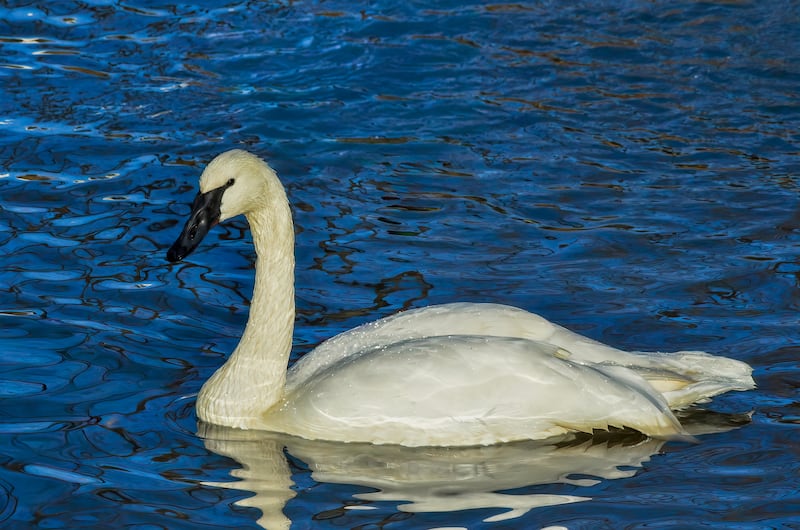
What would have seemed improbable just a few decades ago, wild swans have now returned to the Fox River valley and across Kane County.
Decades of rehabilitation efforts by community environmental groups, local governments, the U.S. Environmental Protection Agency, even school kids, helped the river and its ecosystem come back to life, turning its swan song around.
The abundance of swan sightings is exciting local experts because outside their poetic beauty, their return marks a significant milestone in restoring the health of the watershed ecosystem.
John Sprovieri, president of the Kane County Audubon Society, said their resurgence signifies balance being restored through years of coordinated efforts.
“It’s so special seeing these huge white birds gliding effortlessly along the river, with their long, elegant necks,” Sprovieri said. “We’ve done such a great job in recent years to improve the health of the Fox River and our local wetlands. One of the easiest things we can do is pick up litter (and volunteer for clean-ups.)”
:quality(70)/cloudfront-us-east-1.images.arcpublishing.com/shawmedia/KL6UVD2Z3NCSFIF6GRJB4IFLKM.jpg)
Volunteers picked up more than 12 bags of trash in just one clean-up day along the river at Buffalo Rock Forest Preserve in Algonquin, he said.
Keeping the ecosystem pristine from trash and pollution because the swans’ diet depends on fragile plant species.
“Swans feed on underwater plants, and if the river is polluted or full of dirt from run-off, it cannot support plant life, so you won’t see swans,” Sprovieri said.
:quality(70)/cloudfront-us-east-1.images.arcpublishing.com/shawmedia/HQDP7DA67ZG6DJDMBVNY2HXQWQ.jpg)
The Conservation Foundation hosts an annual clean-up day for volunteers called It’s Our Fox River Day At a previous clean-up at Ferson Creek Forest Preserve in St. Charles, U.S. Rep. Bill Foster, D-Naperville, said it’s been remarkable seeing the Fox River transform from an “industrial dumping ground” to a flourishing ecosystem.
:quality(70)/cloudfront-us-east-1.images.arcpublishing.com/shawmedia/EDJKHP2YCFHS3GAE63VU6WBIDI.jpg)
“When I moved here more than 40 years ago, people warned me don’t buy property down by the Fox River because it stinks from untreated sewage being dumped in and leaky septic tanks,” Foster said in a previous interview.
He said the wildlife, including great blue herons and bald eagles, returned once the EPA and river towns worked together to upgrade water treatment plants to ensure contaminant removal before the water is released into the environment.
Different species can be seen
From habitat degradation and over-hunting, wild swans once vanished from Illinois more than a century ago.
Three types of swans now have been seen in the waters around St. Charles and other near towns along the Fox River. All three can be spotted from early November through March before they head north to Canada and Alaska for the spring and summer to breed and nest.
:quality(70)/cloudfront-us-east-1.images.arcpublishing.com/shawmedia/TTHJ42VT5RA4XKBELRQDW75ZQI.jpg)
The Fox River Valley is part of the Mississippi Flyway, one of the major migratory bird routes across North America, spanning 2,300-miles across the continent, from the Gulf of America to the far reaches of the arctic.
The Fox River region has become a magnet for swans because of the open, clean water on the river and the availability of waste corn in harvested agricultural fields makes for a perfect layover before continuing on their journey, Sprovieri said.
:quality(70)/cloudfront-us-east-1.images.arcpublishing.com/shawmedia/7RNKNTVCNJFLDBHLRX6HJKCKK4.JPG)
Two swan species, the trumpeter swan and the tundra swan, are native to the area.
Mute swans have been imported from Europe and often escape captivity. They are considered invasive because their aggressive nature and insatiable appetite displaces native birds.
Mute swans have the typical reddish-orange bill and a black face. From a distance, their necks curl more in an S shape than other species, and like their name implies, they are far less vocal than other swans.
The harder part is identifying between the two native species. Sprovieri said after 20 years of birding he still sometimes mistakes trumpeter and tundra swans.
Tundra swans have a mostly black bill, often with a yellow spot near their eye. At 13 to 20 pounds, they are often a third smaller than trumpeter swans. They can fly at speeds up to 50 mph and breed along the shores of the arctic.
The air whistling through their wings in flight can be heard even from 100 feet away.
In comparison, at 20 to 30 pounds and 4 to 5 feet in length, with a 6- to 10-foot wingspan, trumpeter swans are the largest native waterfowl in the continent and one of the heaviest flying birds in the world.
Their bills are all black, with no yellow like tundra swans. Their necks and bills are also much longer than tundra swans. Trumpeters tend to honk, like a trumpet, while tundra swans whistle and hoot.
Where to view them
Sightings can happen anywhere there is open water along the Fox River. Birding hotspots are located across the Fox River Valley.
Outside of St. Charles, sightings have been recorded in Island Park and Bennett Park in Geneva. Swans also frequent SEBA Park in South Elgin, Island Park in North Aurora, and Elgin Shores Forest Preserve in Elgin.
Swans often congregate where the dam has been removed in Carpentersville. They are often frequently seen nearby in the river along West Dundee.
When ice covers the Fox River, Sprovieri said some hotspots include Muirhead Springs Forest Preserve in Hampshire, Dick Young Forest Preserve in Batavia, and Lake Law and the AE Sea at Fermilab in Batavia.
You can learn more about the Kane County Audubon Society by visiting, kanecountyaudubon.com/.
:quality(70)/s3.amazonaws.com/arc-authors/shawmedia/0cef0bf9-a04e-4bb4-aea0-03d8ced01c00.jpg)