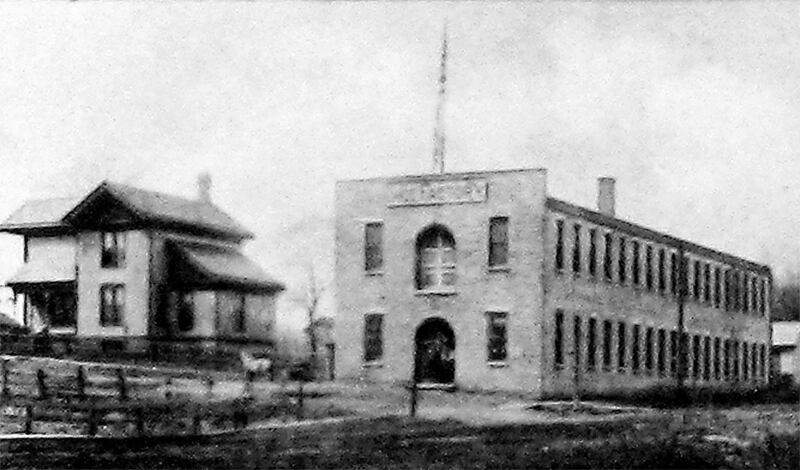
The stone building on the corner of Water Street and Fourth Avenue has been a familiar sight in Kankakee for more than a century. In the early 1900s, Kankakeeans referred to it as "the old shoe factory building." A later generation knew it as "the overall factory." Since 1972, it's been the home of a heating equipment and sheet metal company.
The stone structure was built in 1885 by Merritt Teed to house his growing shoe manufacturing business, which he had begun four years earlier in a wooden building located one block to the east. An 1883 newspaper report on Kankakee manufacturers noted "M. Teed & Son employ a force of about 30 hands in the manufacture of women's and misses' shoes. Their factory is fully supplied with all the latest improved machinery, and they are turning out about 25 cases of shoes per day."
Teed paid $3,000 to purchase the entire block bounded by Fourth Avenue, Water Street, Fifth Avenue and Charles Street. The new, two-story stone factory, which eventually would provide work for 35 men and 20 women, was built on the northeast corner of the property. The rest of the block was subdivided into residential lots; houses for Teed and his son, Ed, were erected facing Fourth Avenue.
In the early 1890s, business was booming, with the factory turning out 300 pairs of shoes per day. Unfortunately, the boom didn't last — a national financial depression began in 1893. The Teed shoe factory, similar to many other businesses across the country, was forced to close its doors. In late 1894, a St. Louis investor bought the business and revived it for a time, but by some time in 1897, it closed for good.
The building wasn't vacant for long. Late in 1897, Henry Pope Sr. decided to relocate his stocking knitting business from Chicago to Kankakee and moved into the former shoe factory. His Paramount Knitting Co. began turning out Bear Brand stockings while he laid plans for a larger factory building. In 1902, Paramount moved into its new factory at Washington Avenue and Hickory Street. Once again, the old stone building became vacant.
In 1904, a firm making photographic paper bought the building but operated there for only a year. The building acquired a new owner in April 1905 and began a new manufacturing era: for most of the next 66 years, its product would be clothing.
The new owner was Bernstein, Cohen & Co., manufacturers of work clothing, specifically men's overalls. The new owners replaced the stone panel on the front of the building that read, "Shoe Factory" with one bearing their names. At some time before 1913, they expanded the building to the south with a two-story addition, doubling it in size. In 1935 or 1936, the factory apparently closed, since the 1937 city directory listed the building's occupant as "Bear Brand Warehouse."
In 1941, clothing manufacturing returned to the building under the name of Commercial Uniform Factory Inc. When World War II broke out, Commercial Uniform Factory was among the many local businesses switching over to production for the war effort. They won a contract to produce military uniforms. By the late 1940s, the company had formed a subsidiary, Peerless Pants Co. That firm, housed in the same building, produced women's slacks. Peerless continued in operation until the late 1960s. In 1961 and 1962, the building also housed an unrelated startup business, Kankakee Industrial Supply. It later moved to a location on Jeffery Street, where it operated for many years.
A new name appeared at 403 S. Fourth Ave. (the building's street address) in the 1969 city directory. Airshire Co. was a manufacturer of ladies' and children's coats. It remained in operation until late 1971 or early 1972, when the building's long history of clothing manufacture came to an end.
The new owner, in 1972, was Harold E. Sippel, who used the building to house his company, S&S Heating and Sheet Metal Inc. For the third time in its history, the stone panel identifying the building changed: Bernstein, Cohen & Co. was replaced by H.E. Sippel & Son's. For the past 46 years, that panel, and the building's occupancy, has remained unchanged.