<strong>Dear Jill:</strong> My local supermarket has a limit of five on their electronic coupons. You can use each of these coupons up to five times per transaction. However, if you go to the store through the checkout lane again for another trip, you can use them for another five items. You can keep making separate trips over and over again as long as you don’t use more than the limit of five.
My question is, do you think there is anything wrong with doing this? There is nothing in the ad saying that you cannot. I feel I am just making separate trips. I also don’t think it is very much different than if my husband went and also bought 5 with his app’s identical coupons. I am curious to hear your thoughts. <strong>— Alicia E.</strong>
As long as the store’s electronic coupons are limited to five per transaction and not five per shopper, what you’re doing is fine. The store certainly has the ability to remove these offers from their coupon app if they would like to restrict them to just five total uses versus five uses per shopping trip. I’m aware of some retailers that limit their re-use of ecoupons to one transaction every 24 hours, but other stores do not. Your next trip could take place a few minutes later, or a few days later.
To answer your second question, there is no difference from a store’s-stock-reduction standpoint whether you and your husband go to the store and each purchase five items in your own shopping trips, or whether you make a shopping trip of five items, then return to the store and make a second transaction. In each instance, 10 of these same items will have been removed from the shelves.
In cases where a store’s policy allows shoppers to use another round of the same ecoupons on a subsequent trip, it’s likely that the limits are designed to slow the rush of featured items from disappearing from shelves too quickly – but also not limit shoppers to only five total of that particular item. They may recognize that they want some “slow the flow” limits in place without placing finite limits.
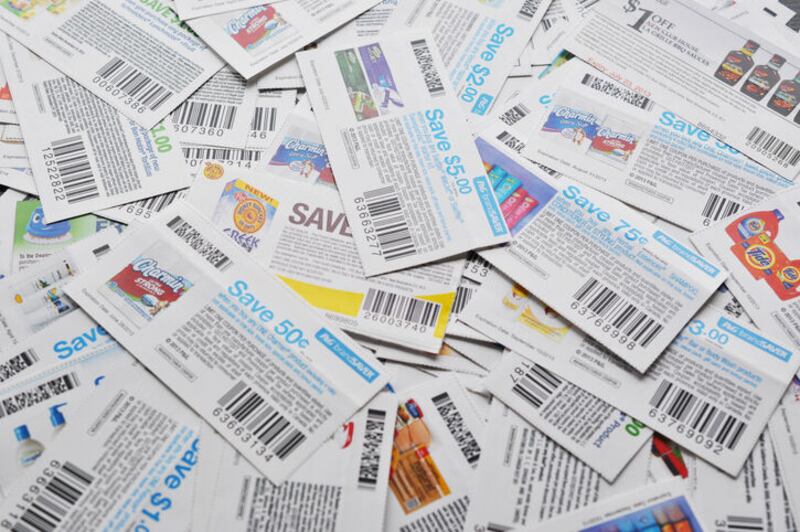
<strong>Dear Jill:</strong> Why do some coupons say, ‘Limit one per purchase’ or ‘Limit one per transaction?’ I know with paper coupons, if it says either one of these things and you use two of the same coupons, they still go through at the register just fine. What is the difference? <strong>— Marna F.</strong>
The easiest way to explain the difference is this – every item you buy is a purchase. Every group of purchases that you buy and pay for together is one transaction. If you have ten items on the belt at the supermarket, you can mentally think about them as purchase, purchase, purchase – and so on. Every single item is a purchase.
As you travel through the lane and pay for all of your purchases, you’ve completed one transaction.
When a coupon says it is limited to “one per purchase,” it means that you can use one coupon per each item purchased. So, if you have three coupons for $1.00 off a bottle of juice, you can buy three different bottles, use the three coupons, and save $1.00 on each bottle.
If you have coupons for $1.00 off two boxes of cereal, each group of two boxes is one “purchase,” and you can use one coupon for every two boxes you’re purchasing. However, a coupon limited to one per transaction should only be used on one trip through the checkout lane.
It is true that some paper coupons do not have this limitation encoded in them, and if multiples were scanned in the same trip, the register would allow them to go through. These restrictions may be relying on the cashier to read the terms of the offer and disallow multiple like coupons in the same shopping trip. While this does not always happen, it’s still advisable, and ethical, to follow the rules of the offer.